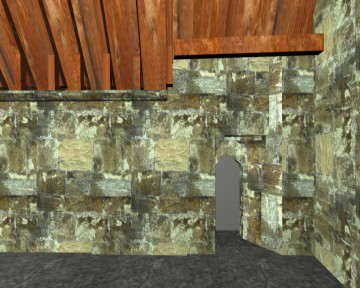
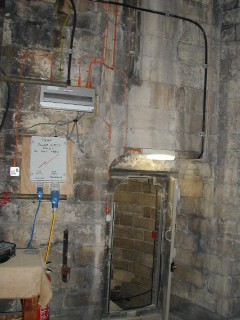
A first impression seems to be that the Masons' Loft is well hidden from the eyes of the Minster's visitors, enhancing the mystery of the place. A door located behind the main entrance into the Chapter House provides access to a narrow, steep staircase that leads to the upper floor of the vestibule (fig.1 and 2).
Originally, the vestibule's design was for a much lower, single-storeyed structure, possibly with a timber vault, but somewhere in the early 14th century, it was decided to change the design and create the room above the vault at the first floor level that is now known as the Masons' Loft. Harvey suggests this was a mid 14th century addition, but others that it occurred during the construction of the Chapter House vestibule(Coldstream, 1972 & Wander, 1978). The adding of the room caused more changes to the shape and structure of the building. Internally, on the Masons' Loft, a sequence of mortice holes is visible, which were designed to accommodate the roof timbers of the original design. In addition, there is a slight off-set next to the entrance of the room, that shows where the walls were heightened (fig.3).The change in design appears to have occurred after the completion of the buttresses. The decision not to rebuilt the buttresses was misguided since they are technically not high enough to provide sufficient structural support for the height of the building. Ongoing research by Kate Giles, the York Minster Research Fellow, has enabled archaeologists to resolve the debate about the sequence of construction. It is now certain that the change in design occurred during the construction of the building and resulted in the heightening of the walls and the creation of the loft.
Fig.1: The model's entrance. Fig.2: The entrance.
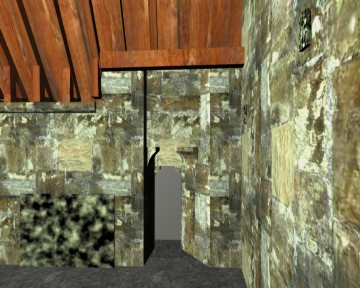
Fig.3: The off-set and the mortice holes, textured so as to be visible.
Page created 23 August 2002 by Vicky Sypsa
Last updated 30 august 2002
©University of York