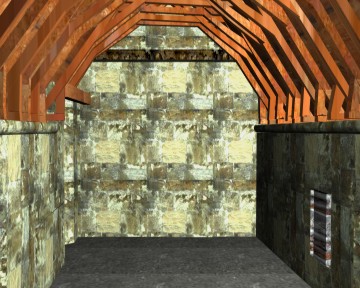
The peculiarity of the room continues as one observes the ornamental details. None of them were intended to form part of the room's architectural decoration, which otherwise is very simple. The windows and entrance have plain rims and there is no other decorative item. Instead, the most important decoration in the room comes from the walls of the buildings which the vestibule abuts.
The wall at the east end of the room is a wall of the Chapter House(fig.1). Near the roof it carries a deeply carved horizontal floriate moulding (fig.2 and 3). This moulding is part of the cornice at the base of the projecting parapet which runs round all eight sides of the Chapter House visible externally.
Fig.1: The model's Chapter House wall.
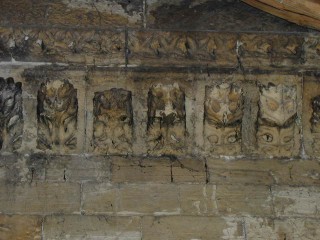
Fig.2: The floriate moulding.
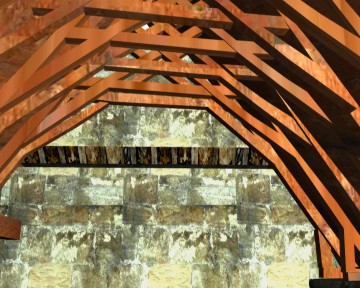
Fig.3: The model's floriate moulding.
The wall at the south end of the room is that of the North Transept (fig.4). This wall is full of decorative details.One of them is the ornamental roof line, that belongs to the east aisle of the early 13th century north transept, and can be seen in a very good state of preservation (fig.5). But the most interesting feature is the elaborately decorated head of a lancet, showing the heads of a king and queen with dogtooth moulding, very well preserved (fig.6). The lower part of this lancet can be seen at the top of the transept's wall when looking from inside the ground floor of the vestibule.
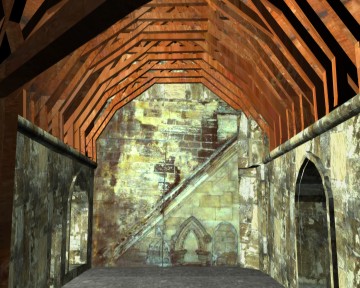
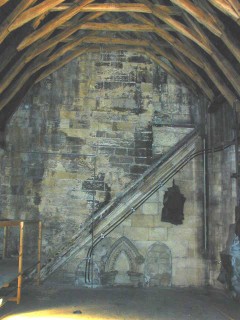
Fig. 4: The model's North transept wall. Fig. 5: the North transept wall.
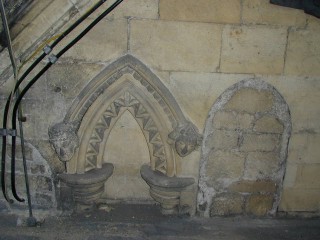
Fig. 6: The lancet.
Page created 23 August 2002 by Vicky Sypsa
Last updated 30 August 2002
©University of York