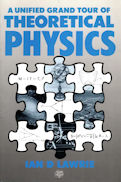
Ian D. Lawrie.
A Unified Grand Tour of Theoretical Physics.
Adam Hilger. 1990
A unique feature of the presentation is the emphasis on unifying relationships between areas of physics which are usually regarded as independent. The geometrical ideas which unite the relativistic theory of gravity with gauge theories of the other forces and the formal similarities between quantum field theory and statistical mechanics are clearly brought out, while the ubiquitous roles of symmetry and action principles in determining the essential structure of physical theories are stressed throughout.
The starting point is geometry and classical physics, where symmetries and action principles first appear. General relativity and the account it provides of gravitational phenomena, including black holes, are then described. Quantum mechanics, the other major theory of twentieth-century physics, is introduced next, leading to a discussion of quantum field theory and relativistic wave equations. The role of the geometrical concepts of ‘fibre bundle’ and ‘connection’ in the gauge theories which have proved fundamental to understanding particle physics is then explained. A discussion of interacting relativistic field theories is given next, including path integrals, renormalization and quantum electrodynamics. Two subsequent chapters deal with equilibrium statistical mechanics and the theory of phase transitions, introducing the idea of spontaneous symmetry breaking which is vital to unified theories of the fundamental interactions. A comprehensive outline of these theories follows, including electroweak theory, quantum chromodynamics and grand unification. In the concluding chapter, the author illustrates much of the preceding material with a fascinating account of recent ideas about the early universe. ‘Snapshot’ summaries of the main themes are provided to give a concise view of the complex theoretical structures involved.
This book will appeal to final-year undergraduates in physics and mathematics, beginning postgraduates in theoretical and particle physics, and to scientists whose area of expertise lies outside the material covered here.