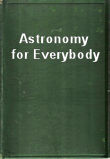
A friend of mine was clearing out her parents’’ house when she cam across this book,
a school prize presented to her grandfather in 1908.
She though I might like it.
She was right; I like it on so many levels.
First is purely material.
It just feels nice to hold: a great shape and weight.
It is beautifully produced hardback,
with high quality paper,
with the top edge gilded,
and the pages properly sewn so that it opens nicely.
Hilariously, the title page proclaims that this is the CHEAP EDITION.
Once I got over fondling it, I thought about the publication date: 1907.
Oh. They wouldn’t have known about
Pluto.
Even more so, they wouldn’t have known that there were multiple galaxies, or that the
universe was expanding.
They wouldn’t have known
what made the sun shine.
They wouldn’t even have known
what the sun was made of.
We have come a long way in 120 years.
I wonder what people will say of our knowledge in 2146?
"Gosh, they didn’t even know
what dark matter was made of!"
So I skimmed the chapter on the Sun.
Lots of stuff about sunspots, prominences, solar rotation, and so on.
Then we get to a passage on the sun’s composition.
p102.
It does not seem likely that there is any solid matter on the sun.
[...] Attempts have sometimes been made to learn the temperature of the photosphere.
It probably exceeds any that we can produce on earth, even that of the electric furnace,
else how could calcium, the metallic base of lime, one of the most refractory of substances,
exist there in a state of vapour?
Next, on the source of the sun’s heat.
pp104–105.
A very simple calculation will show that if the sun were of the nature of a white-hot ball it would cool off so rapidly that its heat could not last more than a few centuries. But it has in all probability lasted millions of years. Whence, then, comes the supply? The answer of modern science to this question is that the heat radiated from the sun is supplied by the contraction of size as heat is lost. [...]
[...] The contraction of a gaseous body, such as we believe the sun to be, is greater than that of a solid or liquid. The heat of the sun is radiated from streams of matter constantly rising from the interior, which radiate their heat when they reach the surface. Being cooled they fall back again, and the heat caused by this fall is what keeps the sun hot.
[...] in order to keep up the supply of heat it is only necessary that the diameter of the sun should contract about a mile in twenty-five years—or four miles in a century. This amount would not be perceptible until after thousands of years. Yet the process of contraction must come to an end some time. Therefore, if this view is correct, the life of the sun must have a limit. What its limit may be we cannot say with exactness, we only know that it is several millions of years, but not many millions.
And finally, on the origin of the sun.
pp105–106.
The same theory implies that the sun was larger in former times than it is now, and must have been larger and larger every year that we go back into its history. There was a time when it must have been as large as the whole solar system. In this case it could have been nothing but a nebula. We thus have the theory that the sun and solar system have resulted from the contraction of a nebula—through millions of years. This view is familiarly known as the nebular hypothesis.
The question whether the nebular hypothesis is to he accepted as a proved result of science is one on which opinions differ. There are many facts which support it—such as the interior heat of the earth and the revolution and rotation of the planets all in the same direction. But cautious and conservative minds will want some further proof of the theory before they regard it as absolutely established. Even if we accept it, we still have open the question: How did the nebula itself originate, and how did it begin to contract? This brings us to the boundary where science can propound a question but cannot answer It,
I quote these passages at length not to mock,
for scientific ideas are being applied rigorously and correctly.
Yet the conclusions are completely wrong, because the premises are wrong:
the wrong science is being applied.
Today, we have our understanding of the Big Bang, inflation, cosmology, and more,
and we have our understanding of particle physics, the Standard Model, and more.
We confidently apply this sophisticated knowledge to infer properties
of things we have not yet discovered.
Are we right, or are we like the astronomers of a century ago,
missing some crucial new mechanisms that are needed to explain the observations?
This book is a wonderful window on the past,
and a salutary lesson about doing valid reasoning, but still getting the wrong answer.
Many thanks to my friend for passing this book on to me!