Books

Short works

Books : reviews

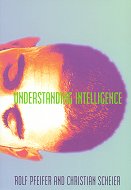
Rolf Pfeifer, Christian Scheier.
Understanding Intelligence.
MIT Press. 1999

By the mid-1980s researchers from artificial intelligence, computer science, brain and cognitive science, and psychology realized that the idea of computers as intelligent machines was inappropriate. The brain does not run “programs”; it does something entirely different. But what? Evolutionary theory says that the brain has evolved not to do mathematical proofs but to control our behavior, to ensure our survival. Researchers now agree that intelligence always manifests itself in behavior—thus it is behavior that we must understand. An exciting new field has grown around the study of behavior-based intelligence, also known as embodied cognitive science, “new AI,” and “behavior-based AI.”

Rolf Pfeifer and Christian Scheier provide a systematic introduction to this new way of thinking about intelligence and computers. After discussing concepts and approaches such as subsumption architecture, Braitenberg vehicles, evolutionary robotics, artificial life, self-organization, and learning, the authors derive a set of principles and a coherent framework for the study of naturally and artificially intelligent systems, or autonomous agents. This framework is based on a synthetic methodology whose goal is understanding by designing and building.

Rolf Pfeifer, Josh C. Bongard.
How the Body Shapes the Way We Think: a new view of intelligence.
MIT Press. 2007

How could the body Influence our thinking when it seems obvious that the brain controels the body? In How the Body Shapes the Way We Think, Rolf Pfeifer and Josh Bongard demonstrate that thought is not independent of the boedy but is tightly constrained, and at the same time enabled, by it. They argue that the kinds of thoughts we ere capable of have their foundation in our embodiment—in our morphology and the material properties of our bodies.

This crucial notion of embodiment underlies fundamental changes in the field of artificial intelligence over the past two decades, and Pfeifer and Bongard use the basic methodology of artificial intelligence—“understanding by building”—to describe their insights. If we understand how to design and build intelligent systems, they reason, we will better understand intelligence in general. In accessible, nontechnical language, and using many examples, they introduce the basic concepts by building on recent developments in robotics, biology, neuroscience, and psychology to outline a possible theory of intelligence. They illustrate applications of such a theory in ubiquitous computing, business and management, and the psychology of human memory. Embodied intelligence, as described by Pfeifer and Bongard, has important implications for our understanding of both natural and artificial intelligence.