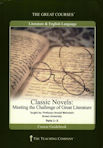
Arnold Weinstein.
Classic Novels: meeting the challenge of great literature.
Great Courses. 2007
rating : 5 : waste of time
review : 19 September 2026
This is the course guidebook that accompanies the 36 lecture “Great Course” of the same name. It is essentially an abbreviated transcript of each lecture, a few pictures, and some related reading. (I watched the lectures, which is what I am reviewing here, and am using the online book simply as an aide-memoire.)
This is another Great Course trawl through Great Literature. I’ve recently watched Sutherland’s Classics of British Literature and Damrosch’s Rise of the Novel, and enjoyed them both (although, to be fair, neither left me wanting to read any of the books covered).
This course, not so much. Too much Freud, too much God, too wishy-washy, too Male Gaze, not enough interesting insight. Here are two examples of male gaze. First, when describing a particular scene in Proust, he mentions that some of his female students find it objectionable, but, oh, it’s written so beautifully. Of course they find it objectionable: it’s a rape scene! Second, in To the Lighthouse he reads a scene of Mrs Ramsay sitting up, raising herself with an effort, and turning her attention to her husband, who needs his daily dose of praise. Weinstein describes this in terms of her being a goddess and representing life; I however can almost see the vitriol dripping from Woolf’s pen. Furthermore, we clearly do not share a sense of humour: his claim that Ulysses is “hilariously funny” is certainly not supported by any of the scenes he describes. Yet he claims that a scene at the fair in Madame Bovary, where Rodolphe is declaring his love for Emma, and a prize is announced for manure, to be vitriolic; I just found it an amusing way to deflate pretentiousness.
I watched all 36 lectures, but only so I could make sarcastic and exasperated comments at the screen. I did, however, learn something from this: that a madeleine is a biscuit. I had vaguely assumed, given that the scene is all about the evocativeness of smell (but without, obviously, having read the book) that it was some sort of fruit…