
2D magnetic materials
In 2017 experiments showed for the first time that magnetism can survive in a single layer of a crystal just a few atoms thick. These van der Waals magnets, such as CrI3 and CrCl3, consist of atomic layers held together by weak forces, so that individual layers can be peeled apart in the same way as graphene. Their discovery was surprising. A long-standing result of theoretical physics, the Mermin-Wagner theorem, states that long-range magnetic order cannot exist in a two-dimensional magnet with isotropic short-range interactions. 2D magnets therefore offer a new testing ground for fundamental physics, and their atomic thinness and the ease with which they can be stacked with other 2D materials make them promising candidates for ultra-compact spintronic devices.
To understand how magnetism works in these materials we use atomistic spin models, parameterised from first-principles calculations, which capture the behaviour of every magnetic atom in a flake. Much of this work has been carried out in close collaboration with Elton Santos and Kostya Novoselov.
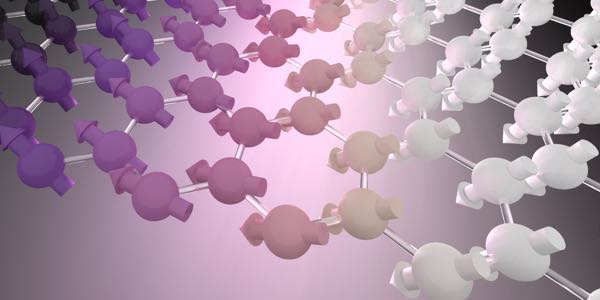
Visualisation of the atomic spins in a two-dimensional magnet with a honeycomb lattice. The colour indicates the direction of the spins, which rotate across a domain wall between two regions of opposite magnetisation.
Magnetic order in two dimensions
We first consider why 2D magnets order at all. We showed that in flakes of the size typically studied in experiments, short-range interactions can be strong enough to stabilise magnetic order at finite temperature even without any magnetic anisotropy [1]. Remarkably, the loss of order predicted by the Mermin-Wagner theorem would only be observed in flakes comparable in size to the observable universe. In addition, we showed that higher-order biquadratic exchange interactions are important in layered magnets, modifying their anisotropies and spin-wave gaps and explaining the discrepancy between measured and calculated Curie temperatures [2]. Earlier first-principles and Monte Carlo calculations predicted that single layers of the transition-metal dichalcogenides VX2 are magnetic semiconductors with Curie temperatures close to or above room temperature [3, 4].
Domains, domain walls and topological textures
For 2D magnets to be useful in devices we need to understand how their magnetic domains form and move. In CrI3 we found metastable magnetic domains separated by unusual hybrid domain walls, and showed how quantum effects rescale its temperature-dependent properties [5]. In CrCl3, vortex-like textures known as merons and antimerons emerge spontaneously at zero magnetic field, stabilised by the competition between dipolar interactions and a weak magnetic anisotropy [6]. We have also studied how domain walls move in 2D ferromagnets [7] and in the van der Waals antiferromagnet MnPS3, where domain walls reach velocities of around 3000 m/s and display relativistic effects such as Lorentz contraction and the emission of terahertz spin waves [8].
Ultrafast dynamics
Most recently we developed a model of ultrafast laser-induced demagnetisation in 2D magnets that reproduces the two-step demagnetisation seen in experiments on CrI3. The model shows that the slower second step arises from heating of the substrate on which the flake sits, an effect which is specific to 2D systems [9]. We have also explored how the magnon spectrum of CrI3 can be engineered to open topological gaps [10], and contributed to a broad review of magnetism in 2D van der Waals materials [11]. Atomistic models of this kind allow the magnetic properties of a 2D flake to be calculated from first-principles parameters, which is needed before such materials can be designed into spintronic devices.
Related publications
[1] Jenkins et al, Breaking through the Mermin-Wagner limit in 2D van der Waals magnets, Nature Communications 13 6917 (2022)
[2] Kartsev et al, Biquadratic exchange interactions in two-dimensional magnets, npj Computational Materials 6, 150 (2020) 
[3] Fuh et al, Newtype single-layer magnetic semiconductor in transition-metal dichalcogenides VX2 (X= S, Se and Te), Scientific Reports 6, 32625 (2016)
[4] Vatansever et al, Hysteresis features of the transition-metal dichalcogenides VX2 (X=S, Se, and Te), Mater. Res. Express 5 046108 (2018)
[5] Abdul Wahab et al, Quantum Rescaling, Domain Metastability, and Hybrid Domain‐Walls in 2D CrI3 Magnets, Advanced Materials 2004138 (2020)
[6] Augustin et al, Properties and dynamics of meron topological spin textures in the two-dimensional magnet CrCl3, Nature Communications 12 185 (2021)
[7] Abdul-Wahab et al, Domain wall dynamics in two-dimensional van der Waals ferromagnets, Applied Physics Reviews 8 041411(2021)
[8] Alliati et al, Relativistic domain-wall dynamics in van der Waals antiferromagnet MnPS3, npj Computational Materials 8 3 (2022)
[9] Strungaru et al, Substrate Contribution to Ultrafast Spin Dynamics in 2D van der Waals Magnets, Physical Review Letters 135 076701 (2025)
[10] Brehm et al, Topological magnon gap engineering in van der Waals CrI3 ferromagnets, Physical Review B 109 174425 (2024)
[11] Wang et al, The Magnetic Genome of Two-Dimensional van der Waals Materials, ACS nano 16 6960-7079 (2022)


