
Antiferromagnets
Most people picture a magnet as a material in which the atomic magnetic moments all point the same way, producing the external field that holds a note to a fridge. In an antiferromagnet, neighbouring atomic moments instead point in opposite directions, so that their magnetism cancels out and the material has no net magnetisation at all. Antiferromagnets are in fact far more common than ferromagnets, and their hidden order brings several advantages for technology. Without a net moment they produce no stray magnetic fields and are largely immune to external ones, and their magnetic dynamics occur at terahertz frequencies, around a thousand times faster than in conventional ferromagnets. However, the same properties make antiferromagnets notoriously difficult to control and to measure, and our understanding of their behaviour at the atomic scale has lagged far behind their use in devices.
To understand antiferromagnets from the bottom up we use atomistic spin models, which resolve the magnetic moment of every atom in the material and are implemented in our open source vampire software package. This allows us to capture directly the complex spin arrangements, atomic disorder and interfaces that determine their properties, and to connect these microscopic details with the measurements made by our experimental collaborators.
Exchange bias and IrMn
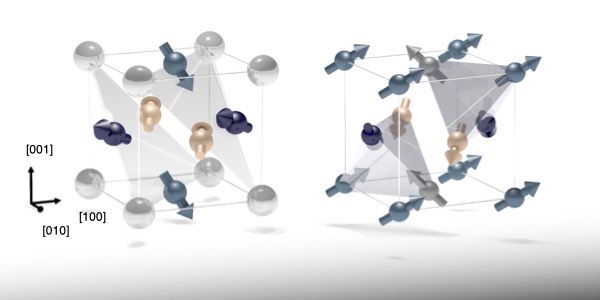
Visualisation of the non-collinear spin structure of IrMn3. The atomic moments form a complex three-dimensional arrangement, which makes the material challenging to describe with simple models.
Antiferromagnets have been hidden inside everyday technology for decades. Hard disk read heads and magnetic memory (MRAM) cells contain a thin layer of the antiferromagnet IrMn, which pins the magnetisation of a neighbouring ferromagnet through an interfacial effect known as exchange bias. It is perhaps surprising then that the microscopic origin of exchange bias has remained a long-standing open problem. In IrMn the difficulty is compounded by its non-collinear spin structure, shown in the figure above, in which the atomic moments point along several different directions.
We first developed a predictive atomistic model of IrMn3 and used it to calculate its magnetic anisotropy, which sets the stability of the antiferromagnet. Theoretical calculations and experimental measurements of this quantity had differed by two orders of magnitude. We found that IrMn3 possesses a cubic-like anisotropy not seen in ferromagnets, and that metastable spin structures lower the energy barrier to a tenth of that expected from simple geometrical arguments, removing the discrepancy between experiment and theory [1]. We then applied the model to the interface between IrMn3 and a CoFe ferromagnet to identify the pinned spins responsible for exchange bias. These arise from a small imbalance in the number of spins on each magnetic sublattice due to naturally occurring atomic disorder. However, they are not isolated defects, and instead consist of a small motion of every antiferromagnet spin at the interface [2]. This unexpected finding resolves one of the long-standing puzzles of exchange bias. Finally, by simulating realistic thin films containing many grains we reproduced experimental values of exchange bias and its temperature dependence, and showed that the increase in coercivity seen at the blocking temperature arises from superparamagnetic flipping of the antiferromagnet grains [3].
Antiferromagnetic spin textures
Ferromagnets can host stable whirls of magnetisation known as skyrmions, which are promising as mobile carriers of information. Antiferromagnetic counterparts of these textures are expected to be particularly attractive for devices, since they combine the robustness of antiferromagnetic order with high mobility. We have shown that bimerons, the in-plane counterparts of skyrmions, can be stabilised in antiferromagnetic thin films and can merge into clusters with a wide range of topological numbers [4]. In collaboration with colleagues in Grenoble, we have also studied how spin textures can be set locally in granular antiferromagnets [5] and how skyrmions and bimerons can be imprinted into an antiferromagnet [6], work which is reviewed in a forthcoming book chapter [7].
Ultrafast and optical control
The terahertz dynamics of antiferromagnets make them natural candidates for control with ultrashort laser pulses. Working with experimental colleagues in Nancy, we have shown that a single femtosecond laser pulse can switch the exchange bias of an IrMn/CoGd bilayer, with our simulations predicting that the antiferromagnet switches and recovers within 2 ps [8]. This is the fastest and most energy-efficient method yet demonstrated to set exchange bias. In addition, our simulations of FeRh helped to explain the large and coherent spin current emitted from its antiferromagnetic phase after laser excitation [9].
Our current work focuses on the metallic antiferromagnet Mn2Au, one of the most promising materials for antiferromagnetic memory. We have predicted that laser-induced optical torques can switch the antiferromagnetic order of Mn2Au by 90 or 180 degrees within picoseconds, and that in contrast to most switching mechanisms the final state can be chosen deterministically [10]. The same torques can drive antiferromagnetic domain walls efficiently [11], while spin current pulses provide a complementary route to controlling the dynamics of Mn2Au [12]. These results suggest that antiferromagnets could form the basis of future memory and logic devices operating at terahertz speeds, a possibility which we continue to explore as part of the AFMNet network in antiferromagnetic spintronics.
Related publications
[1] Jenkins et al, Magnetic anisotropy of the non-collinear antiferromagnet IrMn3, Physical Review B (Rapid Communications) 100 220405(R) (2019) 
[2] Jenkins et al, The atomistic origin of exchange anisotropy in non-collinear γ-IrMn3/CoFe bilayers, Physical Review B 102, 140404(R) (2020)
[3] Jenkins et al, Exchange bias in multigranular non-collinear IrMn3/CoFe thin films, Physical Review B 103 014424 (2021)
[4] Li et al, Bimeron Clusters in Chiral Antiferromagnets, npj Computational Materials 6, 169 (2020)
[5] Leiviskä et al, Local setting of spin textures in a granular antiferromagnet, Physical Review B 108 184424 (2023)
[6] Thevenard et al, Imprinting of skyrmions and bimerons in an antiferromagnet, Physical Review B 111 224429 (2025)
[7] Leiviskä et al, Antiferromagnetic skyrmions in spintronics, In press (2026)
[8] Guo et al, Single-shot laser-induced switching of an exchange biased antiferromagnet, Advanced Materials 36 2311643 (2024)
[9] Hamara et al, Ultra-high spin emission from antiferromagnetic FeRh, Nature Communications 15 4958 (2024)
[10] Ross et al, Ultrafast antiferromagnetic switching of Mn2Au with laser-induced optical torques, npj Computational Materials 10 234 (2024)
[11] Gavriloaea et al, Efficient motion of 90° domain walls in Mn2Au via pure optical torques, npj Spintronics 3 11 (2025)
[12] Zhu et al, Antiferromagnetic dynamics of Mn2Au driven by spin current pulses with perpendicular spin polarization, Applied Physics Letters 126 222401 (2025)


