
Magnetic nanoparticles
Magnetic nanoparticles, typically between a few and a few tens of nanometres across, are used in applications ranging from data storage and ferrofluids to contrast agents for magnetic resonance imaging and magnetic hyperthermia treatment of cancer. At this size a large fraction of the atoms sit at the surface, where their reduced coordination lowers the Curie temperature and their different electronic environment gives rise to a surface anisotropy. As a result the magnetic properties of nanoparticles can differ dramatically from those of the bulk material, and simple models which treat a particle as a single magnetic moment often fail. Atomistic spin models are therefore a natural approach, since they treat surface and interior atoms individually and can include the real shape, crystal structure and defects of the particle.
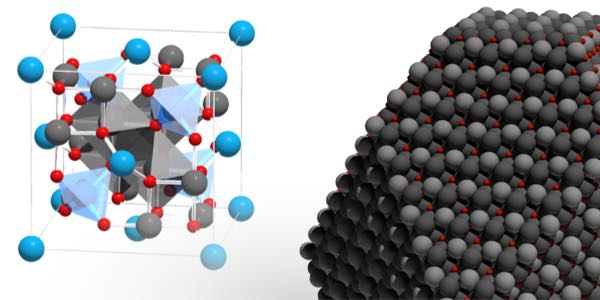
Crystal structure of magnetite, Fe3O4 (left), and part of an atomistic model of a faceted magnetite nanoparticle built from it (right). Modelling every atom allows the effects of the particle surface, shape and defects on its magnetic properties to be included directly.
Surfaces, shape and anisotropy
Our early work considered how surface and finite-size effects change the fundamental properties of nanoparticles, from the Curie temperature of Fe and Co nanoparticles [1] to the magnetic properties of Co-Ag core-shell particles [2, 3]. We showed that the energy of a nanoparticle with Néel surface anisotropy can be represented by an effective single-spin potential containing both uniaxial and cubic terms, whose values and even signs depend strongly on the surface arrangement, internal structure and shape of the particle [4]. Using the constrained Monte Carlo method, we then found that surface effects can dominate at low temperatures, leading to an overall cubic anisotropy even in spherical particles with uniaxial core anisotropy, and to a temperature-induced reorientation transition [5]. These surface and interface effects are reviewed in [6].
Exchange bias in core-shell nanoparticles
Coating a ferromagnetic particle with an antiferromagnetic shell gives rise to exchange bias, which has been proposed as a way of beating the superparamagnetic limit to the size of magnetic grains in data storage. For Co/CoO particles we showed that exchange bias increases the energy barrier along the bias direction but decreases it in the opposite direction, so that the core is stable in only one direction. To allow such particles to be written, we proposed a heat-assisted recording scheme in which heating above the Néel temperature of the shell allows the core to be switched with a small field [7]. We also found that roughness at the core-shell interface produces a wide dispersion of exchange bias, strongly correlated with the net interfacial moment of the antiferromagnet [8]. This work is described in more detail on our exchange bias page.
Magnetite nanoparticles for biomedicine
Magnetite (Fe3O4) nanoparticles are among the most promising candidates for biomedical applications such as magnetic hyperthermia, due to their biocompatibility and good magnetic properties. However, many researchers observe a magnetisation well below that of bulk magnetite. Working with electron microscopy colleagues at York, we found that antiphase boundaries are common in particles with reduced magnetisation, and that strong antiferromagnetic interactions across these defects support multiple magnetic domains even in particles as small as 12–14 nm [9]. In core/shell Fe3O4/MnxFe3-xO4 particles, our simulations showed that the Dzyaloshinskii-Moriya interaction can cause spin canting in the interior of the particle as well as at its surface [10].
The heat generated in magnetic hyperthermia depends on the energy barrier for magnetisation reversal, and so on the effective anisotropy of the particles. We found that for faceted magnetite particles simple analytical formulae overestimate the shape anisotropy, and that the underlying cubic anisotropy makes a significant contribution to the energy barrier of moderately elongated particles [11]. In addition, we developed a dynamical method to fully parameterise the Arrhenius-Néel law, finding an inverse attempt frequency of τ0 = 0.98 ± 0.13 ns for magnetite particles at room temperature, a quantity whose estimates had previously varied over six orders of magnitude and which is important for both hyperthermia and paleomagnetism [12]. Interactions between particles also matter, and change the energy losses of nanoparticle composites in alternating fields in a non-trivial way [13]. Much of this work was carried out within the SUPERMAN project.
Nanodots for data storage and memory
The same methods apply to the patterned nanostructures used in data storage and memory. In FePt nanodots for bit-patterned recording media, magnetically soft edges created by damage during patterning initiate reversal by nucleation, and control of these edges could allow exchange spring media without additional soft layers [14]. In CoFeB/MgO nanodots for magnetic memory, we found that reversal is incoherent and thermally nucleated at device operating temperatures, giving an intrinsic switching field distribution that limits the reliability of very small devices [15]. In each of these systems the magnetic behaviour is set by the real structure of the particle, including its facets, surfaces and defects, and an atomistic description of that structure is needed for the quantitative design of magnetic nanoparticles for technology and medicine.
Related publications
[1] Evans et al, The influence of shape and structure on the Curie temperature of Fe and Co nanoparticles, J. Appl. Phys. 99, 08G703 (2006) 
[2] Evans et al, The Effects of Surface Coating on the Structural and Magnetic Properties of CoAg Core-Shell Nanoparticles, IEEE Trans. Mag. 43, 3106 (2007)
[3] Dorfbauer et al, Effects of Surface Anisotropy on the Energy Barrier in Cobalt-Silver Core-Shell Nanoparticles, J. Mag. Magn. Mater. 316, 791 (2007)
[4] Yanes et al, Effective anisotropies and energy barriers of magnetic nanoparticles with Neel surface Anisotropy, Phys. Rev. B 76, 064416 (2007)
[5] Yanes et al, Temperature dependence of the effective anisotropies in magnetic nanoparticles with Néel surface anisotropy, J. Phys. D: Appl. Phys. 43, 474009 (2010)
[6] Evans et al, Surface and interface effects in magnetic core–shell nanoparticles, MRS Bulletin 38, November, 909 (2013)
[7] Evans et al, On beating the superparamagnetic limit with exchange bias, Euro Physics Letters 88, 57004 (2009)
[8] Evans et al, Influence of interfacial roughness on exchange bias in core-shell nanoparticles, Phys. Rev. B 84, 092404 (2011)
[9] Nedelkoski et al, Origin of reduced magnetization and domain formation in small magnetite nanoparticles, Scientific Reports 7, 45997 (2017)
[10] Oberdick et al, Spin canting in core/shell Fe3O4/MnxFe3-xO4 nanoparticles, Scientific Reports 8 3425 (2018)
[11] Moreno et al, The role of faceting and elongation on the magnetic anisotropy of magnetite Fe3O4 nanocrystals, Scientific Reports 10, 2722 (2020)
[12] Moreno et al, Atomistic calculation of the 𝜏0 inverse attempt frequency in Fe3O4 magnetite nanoparticles, Physical Review B 112 024429 (2025)
[13] Burrows et al, Energy losses in interacting fine-particle magnetic composites, J. Phys. D: Appl. Phys. 43, 474010 (2010)
[14] Liao et al, Atomistic modeling of magnetization reversal modes in L10 FePt nanodots with magnetically soft edges, Phys. Rev. B 90, 174415 (2014)
[15] Meo et al, Thermally nucleated magnetic reversal in CoFeB/MgO nanodots, Scientific Reports 7, 16729 (2017)


