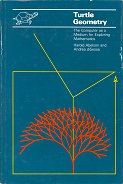
Harold Abelson, Andrea diSessa.
Turtle Geometry: the computer as a medium for exploration.
MIT Press. 1981
rating : 2.5 : great stuff
The not-so-imaginary turtle that brings this book to life is a glowing tracer whose habitat is the display screen of a small computer system. And while this turtle could dash across mathematical terrain to outstrip the quickest jackrabbit student, it moves at a deliberate pace that keeps the process of learning and discovery always under the student’s control. In fact, the students themselves teach the turtle its tricks. (An appendix describes how to translate these tricks into conventional programing languages for widely available personal computer systems.) Many suggestions for computer projects and problems are provided, together with a comprehensive collection of answers and hints. The book illustrates the computational influence in its choice of ideas as well as its choice of activities. Such concepts as representation, local-global dichotomy, linearity, state, and state-change operations, which are usually reserved for more advanced courses in the conventional curriculum, became natural and straightforward when treated from the computational point of view. Still, much of this material is accessible with only the basic technology of pencil and paper.
Some of the subjects covered: random motion, branching processes, space-filling designs, vector operations in two and three dimensions, topology of curves, maze-solving algorithms, intrinsic curvature of surfaces, spherical and ‘cubical’ geometry, piecewise flat surfaces, General Relativity.
General Relativity (and more) in LOGO!