Books

Books : reviews

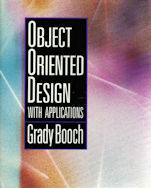
Grady Booch.
Object-Oriented Design with Applications.
Benjamin/Cummings. 1991

Includes five complete application design projects using C++, Smalltalk, Object Pascal, the Common Lisp Object System (CLOS) and Ada.

Object-Oriented Design: With Applications gives you practical guidance for constructing complex object-oriented systems and provides the first comprehensive description of object-oriented design methods. Numerous examples – drawn from the author's extensive experience in developing very large software systems – and five challenging application projects will teach you how to use object-oriented and object-based programming languages to solve real problems.

The First Section: Concepts examines the fundamental elements of the object model and explains techniques to identify classes and objects. Object-oriented programming issues are discussed throughout. The Second Section: The Method then introduces you to a method for object-oriented design (OOD). You’ll study the method’s widely accepted graphical notation and step-by-step design process. Practical advice is also offered on the challenges of managing object-oriented development projects. The Third Section: Applications gives you the opportunity to synthesize OOD concepts and apply the method in five real-world application domains. Each application is a complete design example and is implemented in a different programming language.

Features

• Provides a comprehensive overview of all key object-oriented issues, methods, and languages using numerous real-world examples.
• Teaches a pragmatic method for developing object-oriented systems based on sound software engineering principles.
• Distinguishes between good and bad object-oriented designs and shows how to trade off alternate designs to manage complexity.
• Demonstrates in each application how to implement an incremental and iterative process (analysis, design, evolution, and modification) to tackle realistic, complex problems.
• Includes a detailed appendix on object-oriented programming languages for review and use in the applications.
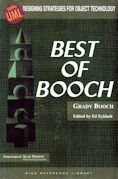
Grady Booch, Ed Eykholt.
Best of Booch.
SIGS. 1996

No one can dispute the impact Grady Booch’s writings have had on object-oriented technology. The Best of Booch contains articles on various object-oriented topics published since Grady Booch’s book Object Oriented Modeling and Design with Applications, second edition. Designed for software professionals who are concerned about the success of their object-oriented projects, this volume covers all aspects of the Booch method and how a complete method must address a model’s notation and semantics as well as a process for creating that model.

Many of the articles have been updated to reflect current thinking in the Unified Modeling Language (UML).

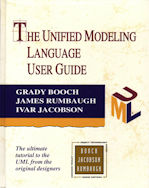
Grady Booch, James Rumbaugh, Ivar Jacobson.
The Unified Modeling Language User Guide.
Addison Wesley. 1999

Introduced in 1997, the Unified Modeling Language (UML) has rapidly been accepted throughout the software industry as the standard graphical language for specifying, constructing, visualizing, and documenting software-intensive systems. The UML provides anyone involved in the production, deployment, and maintenance of software with a standard notation for expressing a system’s blueprint. The UML covers conceptual things, such as business processes and system functions, as well as concrete things, such as programming-language classes, database schemas, and reusable software components. In The Unified Modeling Language User Guide, the original developers of the UML—Grady Booch, James Rumbaugh, and Ivar Jacobson—provide a tutorial to the core aspects of the language in a two-color format designed to facilitate learning. Starting with a conceptual model of the UML, the book progressively applies the UML to a series of increasingly complex modeling problems across a variety of application domains. This example-driven approach helps readers quickly understand and apply the UML. For more advanced developers, the book includes a learning track focused on applying the UML to advanced modeling problems.

With The Unified Modeling Language User Guide, readers will:

• understand what the UML is, what it is not, and why it is relevant to the development of software-intensive systems
• master the vocabulary, rules, and idioms of the UML in order to “speak” the language effectively
• learn how to apply the UML to a number of common modeling problems
• see illustrations of the UML’s use interspersed with use cases for specific UML features
• gain insight into the UML from the original designers of the UML