Books

Books : reviews

Randall Munroe.
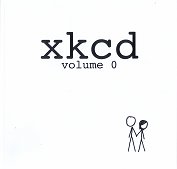
xkcd volume 0.
Breadpig. 2009

rating : 2 : great stuff
review : 25 July 2010

For those of you not following the thrice-weekly webcomic of "romance, sarcasm, math, and language", you have a treat in store, as you get to discover the wonder that is xkcd. For those of you who are following it, you have a treat in store, as you get to experience it again. This is a selection of the strips, in all their glorious clever, witty lunacy. With carefully added hovertext.

So, it doesn't have all the strips, which is a shame. But there will hopefully be further volumes. This is, of course, volume 0. I was discussing with my other half (who got me this for my birthday) how subsequent volumes should be numbered. Binary? To obvious. Hex? Too long until it became clear what was going on. We decided that base 3 was clearly the right approach. Then I noticed the page numbering inside... Proof that we are the right demographic!
Randall Munroe.
What If?.
John Murray. 2014

From the creator of the wildly popular xkcd, What If answers important questions you probably never thought to ask.

Millions visit xkcd.com each week to read Randall Munroe's iconic webcomic. Fans ask him a lot of strange questions.
• How fast can you hit a speed bump, driving, and live?
• What would happen if someone's DNA vanished?
• How many humans would a T Rex rampaging through New York need to eat a day?

In pursuit of answers, he runs computer simulations, digs through declassified military research memos, consults with nuclear-reactor operators, times scenes from Star Wars with a stopwatch, calls his mother, and Googles some very freaky-looking animals. This book features the most popular questions from the blog, but many (51 per cent!) are new.

When Randall Munroe is your guide, science gets really weird really fast. Near-light-speed baseball pitches can level entire city blocks. A mole of moles can suffocate the planet in a blanket of meat. Yoda can use the Force to recharge his electric-model Smart Car. Munroe's hilarious and compelling answers explain everything from the odds of meeting your soulmate to the many ways you could die while building a periodic table out of the actual elements. Welcome to the strange world of What If.

Randall Munroe.
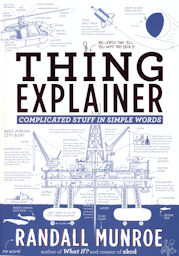
Thing Explainer: complicated stuff in simple words.
John Murray. 2015

From Randall Munroe, the No.1 bestselling author of What If? – the man who created xkcd and explained the laws of science with cartoons – comes a series of brilliantly – and simply – annotated blueprints that explain everything from the nuclear bomb to the biro.

Randall Munroe.
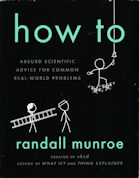
How To: absurd scientific advice for common real-world problems.
Riverhead Books. 2019

The world’s most entertaining and useless self-help guide

For any task you might want to do, there’s a right way, a wrong way, and a way so monumentally complex, excessive, end inadvisable that no one would ever try it. How To ise a guide to the third kind of approach. It’s full of highly impractical advice for everything from landing a plane to digging a hole,

Bestselling author and cartoonist Randell Munroe explains how to predict the weather by analyzing the pixels of your Facebook photos. He teaches you how to tell if you’re a baby boomer or a nineties kid by measuring the radioactivity of your teeth. He offers tips for taking a selfie with a telescope, crossing a river by boiling it, and powering your house by destroying the fabric of spacetime. And if you want to get rid of the book once you’re done with it, he walks you through your options for proper disposal, including dissolving it in the ocean, converting it to a vapor, using tectonic plates to subduct it into the Earth’s mantle, or launching it into the Sun.

By exploring the most complicated ways to do simple tasks, Munroe doesn’t just make things difficult for himself and his readers. As he did so brilliantly in What If?, Munroe invites us to explore the most absurd reaches of the possible. Full of clever infographics and amusing illustrations, How To is a delightfully mind-bending way to better understand the science and technology underlying the things we do every day.