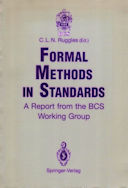
Clive L. N. Ruggles.
Formal Methods in Standards: a report from the BCS Working Group.
Springer. 1990
Formal methods are rapidly increasing in importance in software development and are the equivalent in software engineering of long-established techniques of applied mathematics in other fields of engineering. Standards are important for industry at large, and for software development in particular, promoting consistent quality and economic production.
Formal Methods in Standards brings together for the first time an overview of the development and expression of standards in information technology, and an outline survey of formal methods, together with case studies, issues and guidelines relating to the introduction of formal methods into standards. The case studies span four widely differing application areas: programming languages, document structure, graphics, and open systems interconnection.
There is an extensive bibliography and a substantial glossary of formal methods terminology.
This report was produced by the Formal Methods in Standards Working Group of the British Computer Society. This group was set up to promote the practical application of formal methods in improving the quality of standards used in computer systems and software.