Books

Short works

Books : reviews

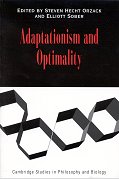
Steven Hecht Orzack, Elliott Sober, eds.
Adaptationism and Optimality.
CUP. 2001

Contents

• Introduction to "Adaptionism and Optimality". 2001
• David A. Baum, Michael J. Donoghue. A Likelihood Framework for the Phylogenetic Analysis of Adaptation. 2001
• Adaptation, Phylogenetic Inertia, and the Method of Controlled Comparisons. 2001
• Hudson Kern Reeve, Paul W. Sherman. Optimality and Phylogeny: A Critique of Current Thought. 2001
• Joel S. Brown. Fit of Form and Function, Diversity of Life, and Procession of Life as an Evolutionary Game. 2001
• Ilan Eshel, Marcus W. Feldman. Optimality and Evolutionary Stability under Short-Term and Long-Term Selection. 2001
• Edward Allen Herre, Carlos A. Machado, Stuart A. West. Selective Regime and Fig Wasp Sex Ratios: Toward Sorting Rigor from Pseudo-Rigor in Tests of Adaptation. 2001
• George W. Gilchrist, Joel G. Kingsolver. Is Optimality Over the Hill? The Fitness Landscapes of Idealized Organisms. 2001
• Kenneth J. Halama, David N. Reznick. Adaptation, Optimality, and the Meaning of Phenotypic Variation in Natural Populations. 2001
• Peter Abrams. Adaptationism, Optimality Models, and Tests of Adaptive Scenarios. 2001
• Ron Amundson. Adaptation and Development: On the Lack of Common Ground. 2001
• Peter Godfrey-Smith. Three Kinds of Adaptationism. 2001
• Egbert Giles Leigh Jr. Adaptation, Adaptationism, and Optimality. 2001

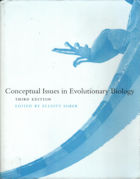
Elliott Sober.
Conceptual Models in Evolutionary Biology: 3rd edn.
MIT Press. 2006

These essays by leading scientists and philosophers address conceptual issues that arise in the theory and practice of evolutionary biology. The third edition of this widely used anthology has been substantially revised and updated. Four new sections have been added: on women in the evolutionary process, evolutionary psychology, laws in evolutionary theory, and race as social construction or biological reality. Other sections treat fitness, units of selection, adaptationism, reductionism, essentialism, species, phylogenetic inference, cultural evolution, and evolutionary ethics.

Each of the twelve sections contains two or three essays that develop different views of the subject at hand. For example, the section on evolutionary psychology offers one essay by two founders of the field and another that questions its main tenets. One sign that a discipline is growing is that there are open questions, with multiple answers still in competition; the essays in this volume demonstrate that evolutionary biology and the philosophy of evolutionary biology are living, growing disciplines.