The Story of Magic Reversal
Tuesday 7 February, 2012
Until now, magnetic switching has relied on an applied field to reverse the direction of magnetisation. The speed of this process is fundamentally limited by the response of the material, and takes at least a nanosecond. Today our article on a novel magnetic switching process has been published in Nature Communications, entitled Ultrafast heating as a sufficient stimulus for magnetization reversal in a ferrimagnet, and demonstrates a completely new mechanism which requires no magnetic field at all. The story of this particular discovery is a fascinating one. About two years ago, Tom Ostler, the lead author of the paper, was performing atomistic simulations of ultrafast reversal in GdFe alloys, looking at the effect of the applied magnetic field on the reversal process. However, the initial results were extremely puzzling: the simulations showed no difference between the applied field being along or against the initial magnetisation direction. In ordinary magnetic materials, this would control the orientation of the magnetisation, as the system prefers to align parallel to the field. So, after a little searching, Tom noted a mistake in the simulation - the applied field was in fact deactivated. What was even more puzzling is that magnetic reversal happened anyway!
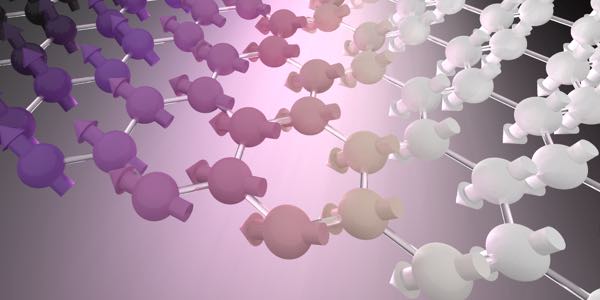
Visualisation of the ultrafast heat induced magnetic reversal process.
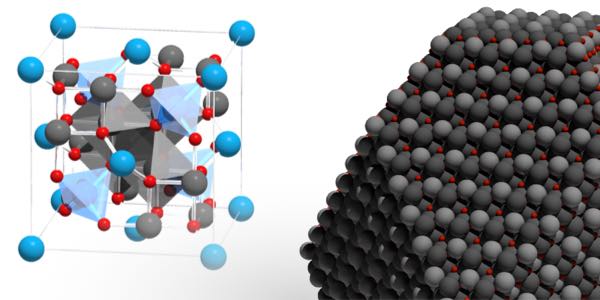
Tom was fully convinced this was a bug in his code, but after a few months of testing and retesting the model, nothing appeared out of order. At this point I performed the exact same simulation with my code, and exactly the same happened - this system switches without any applied field. At this point the informal name for this effect was coined: 'magic reversal'. The switching behaviour was highly counterintuitive, and it took a great deal of time to understand the physical origins behind it. Before the laser pulse, the two components of the ferrimagnetic material Fe (Blue) and Gd (Red) are aligned anti-parallel to each other. The 60 femtosecond duration laser pulse rapidly heats the material and this alone induces a transient ferromagnetic-like state, where the Fe and Gd moments are aligned in parallel. After the laser pulse the moments relax to their usual state completing a single switching event in less than 5 picoseconds. In the meantime however, the theory predicted a highly unusual reversal process, and the key question was - is the same effect seen in experiments? Our colleagues in Nijmegen then proceeded to perform switching experiments, and lo and behold the same effect was seen - deterministic switching in the absence of an applied magnetic field.
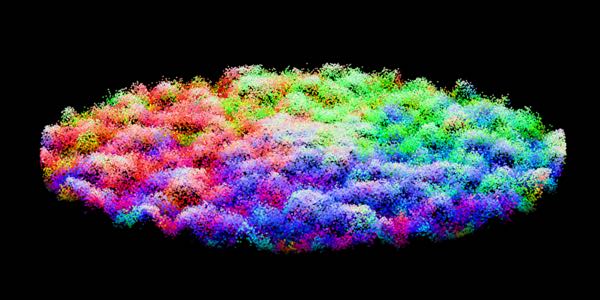
Experimental images showing the repeated deterministic switching of nano islands.
In order to rule out the possibility of stray fields causing the reversal in thin films (stray fields are always present in ferromagnetic materials, and in continuous films can lead to domain processes) colleagues then performed switching experiments on nanometre-sized magnetic dots. Here, the separation between the dots removes the stray field effect, and the switching was seen to occur in that system as well. Initially the two nano islands have different magnetic orientation (black and white respectively). After the application of a single pulse, the magnetic direction of both islands changes. Further pulses repeat the process, switching the magnetic state back and forth. Ultimately heat-induced ultrafast reversal predicted by the simulations was demonstrated experimentally, and presents an exciting new possibility for future magnetic storage.
The ultimate magnetic storage medium.
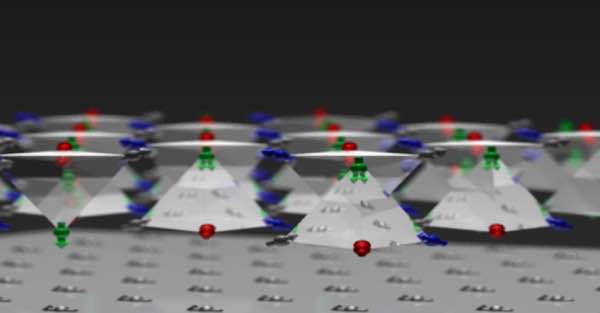
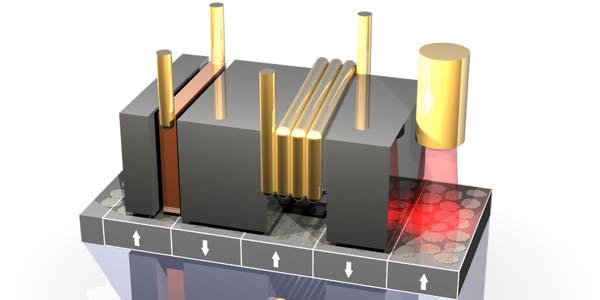
Current magnetic storage in hard disk drives relies on an applied field to switch the magnetisation in the grains. However, ultrafast heat-induced switching removes a fundamental constraint in magnetic storage - the time required to switch the magnetisation. If we are to imagine the ultimate magnetic recording medium consisting of many individual nanometre sized magnetic grains with a density of 10 petabytes/m2. Using the heat induced reversal process the data could be written to the device using an ultrafast heating process to drive the reversal at a data rate of 200Gb/s. Compared to today's hard drive technology this would allow 10 times the amount of storage capacity and 300 times the performance. Of course many challenges to make such a vision a reality still exist, in particular requiring significant developments in the miniaturisation of ultrafast laser sources, magnetic media design, and a greater understanding of the physics behind the reversal process. Further details of the simulations and experiments are available in the published article here.