Mark A. Bedau, Carol E. Cleland, eds.
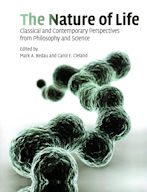
The Nature of Life: classical and contemporary perspectives from philosophy and science.
CUP. 2010
Bringing together the latest scientific advances and
some of the most enduring subtle philosophical puzzles and problems,
this book collects original historical and contemporary sources
to explore the wide range of issues surrounding the nature of life.
Selections ranging from Aristotle and Descartes to Sagan and Dawkins are organized around four broad themes covering classical discussions of life, the origins and extent of natural life, contemporary artificial life creations, and the definition and meaning of “life” in its most general form. Each section is preceded by an extensive introduction connecting the various ideas discussed in individual chapters and providing helpful background material for understanding them. With its interdisciplinary perspective, this fascinating collection is essential reading for scientists and philosophers interested in astrobiology, the origin of life, synthetic biology, and the philosophy of life.
Contents
- • Aristotle. De Anima (selections). 2010
- • René Descartes. Treatise on Man. 1985
- • Immanuel Kant. Critique of the teleological power of judgment (selections). 2001
- • Erwin Schrödinger. What is Life? (selections). 1967
- • Alexander I. Oparin. The nature of life. 1964
- • Ernst Mayr. What is the meaning of "life"?. 1997
- • Tibor Gánti. The principles of life (selections). 2003
- • Leslie E. Orgel. The origin of life: a review of facts and speculation. 1998
- • Robert Shapiro. Small molecule interactions were central to the origin of life. 2007
- • Iris Fry. Are the different hypotheses on the emergence of life as different as they seem?. 1995
- • Norman R. Pace. The universal nature of biochemistry. 2001
- • Steven A. Benner, Alonso Ricardo, Matthew A. Carrigan. Is there a common chemical model for life in the universe?. 2004
- • Kenneth H. Nealson. Searching for life in the universe: lessons from Earth. 2001
- • Carol E. Cleland, Shelley D. Copley. The possibility of alternative microbial life on Earth. 2005
- • National Research Council of the National Academies. Introduction to the limits of organic life in planetary systems. 2007
- • Elliott Sober. Learning from Functionalism--Prospects for Strong Artificial Life. 1992
- • Marc Lange. Life, "artificial life," and scientific explanation. 1996
- • Margaret A. Boden. Alien life: how would we know?. 2003
- • Hod Lipson, Jordan B. Pollack. Automatic design and manufacture of robotic life forms. 2000
- • David W. Deamer. A giant step towards artificial life?. 2005
- • Pier Luigi Luisi, Francesca Ferri, Pasquale Stano. Approaches to semi-synthetic minimal cells: a review. 2006
- • Evelyn Fox Keller. Creating "real life". 2002
- • Carl Sagan. Definitions of life. 1970
- • Daniel E. Koshland. The seven pillars of life. 2002
- • Kepa Ruiz-Mirazo, Juli Peretó, Alvaro Moreno. A universal definition of life: autonomy and open-ended evolution. 2004
- • Carol E. Cleland, Christopher Chyba. Does 'life' have a definition?. 2007
- • Lynn Margulis, Dorion Sagan. Sentient symphony. 2000
- • Kim Sterelny, Paul E. Griffiths. What is life?. 1999
- • Richard Dawkins. Universal Darwinism. 1983
- • Stuart A. Kauffman. What is Life?. 1997
- • Mark A. Bedau. Four puzzles about life. 1998