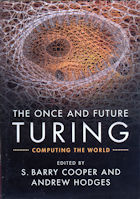
S. Barry Cooper, Andrew Hodges, eds.
The Once and Future Turing: computing the world.
CUP. 2016
Alan Turing (l9l2–l954) made seminal contributions to mathematical logic,
computation, computer science, artificial intelligence, cryptography and theoretical biology.
In this volume, outstanding scientific thinkers take a fresh look at the great range of Turing’s contributions, on how the subjects have developed since his time, and how they might develop still further.
These specially commissioned essays will provoke and engross the reader who wishes to understand better the lasting-significance of one of the twentieth century’s deepest thinkers.
Contents
- • Martin Davis. Algorithms, equations, and logic. 2016
- • J. M. E. Hyland. The forgotten Turing. 2016
- • Andrew R. Booker. Turing and the primes. 2016
- • Ueli Maurer. Cryptography and computation after Turing. 2016
- • Kanti V. Mardia, S. Barry Cooper. Alan Turing and enigmatic statistics. 2016
- • Stephen Wolfram. What Alan Turing might have discovered. 2016
- • Christof Teuscher. Designed versus intrinsic computation. 2016
- • Douglas R. Hofstadter. Dull Rigid Human meets Ace Mechanical Translator. 2016
- • Philip K. Maini, Thomas E. Woolley, Eamonn A. Gaffney, Ruth E. Baker. Turing's theory of developmental pattern formation. 2016
- • Richard Gordon. Walking the tightrope: the dilemma of hierarchical instabilities in Turing's morphogenesis. 2016
- • Stuart A. Kauffman. Answering Descartes: beyond Turing. 2016
- • Scott Aaronson. The ghost in the quantum Turing machine. 2016
- • Solomon Feferman. Turing's 'oracle': from absolute to relative computability and back. 2016
- • P. D. Welch. Turing transcendent: beyond the event horizon. 2016
- • Roger Penrose. On attempting to model the mathematical mind. 2016