Books

Short works

Books : reviews

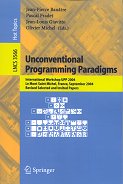
Jean-Pierre Banatre, Pascal Fradet, Jean-Louis Giavitto, Olivier Michel, eds.
Unconventional Programming Paradigms, UPP 2004: Mont Saint Michel, France.
Springer. 2005

Contents

• Philippe Jorrand, Marie Lalire. From Quantum Physics to Programming Languages: A Process Algebraic Approach. 2005
• Peter Dittrich. Chemical Computing. 2005
• Andrew Adamatzky. Programming Reaction-Diffusion Processors. 2005
• Klaus-Peter Zauner. From Prescriptive Programming of Solid-State Devices to Orchestrated Self-organisation of Informed Matter. 2005
• Winfried Kurth, Ole Kniemeyer, Gerhard Buck-Sorlin. Relational Growth Grammars -- A Graph Rewriting Approach to Dynamical Systems with a Dynamical Structure. 2005
• Wolfgang Banzhaf, C. Lasarczyk. A New Programming Paradigm Inspired by Artificial Chemistries. 2005
• Jean-Pierre Banatre, Pascal Fradet, Yves Radenac. Higher-Order Chemical Programming Style. 2005
• Daniel Coore. Introduction to Amorphous Computing. 2005
• Daniel Coore. Abstractions for Directing Self-organising Patterns. 2005
• Jacob Beal. Programming an Amorphous Computational Medium. 2005
• Jean-Louis Giavitto, Olivier Michel, Julien Cohen, Antoine Spicher. Computations in Space and Space in Computations. 2005
• Gheorghe Paun. Bio-inspired Computing Paradigms (Natural Computing). 2005
• Thomas Back, Ron Breukelaar, Lars Willmes. Inverse Design of Cellular Automata by Genetic Algorithms: An Unconventional Programming Paradigm. 2005
• John H. Reif, Thomas H. LaBean, Sudheer Sahu, Hao Yan, Peng Yin. Design, Simulation, and Experimental Demonstration of Self-assembled DNA Nanostructures and Motors. 2005
• Gheorghe Paun. Membrane Systems: A Quick Introduction. 2005
• Gabriel Ciobanu, Dorel Lucanu. Cellular Meta-programming over Membranes. 2005
• Marian Gheorghe, Ioanna Stamatopoulou, Mike Holcombe, Petros Kefalas. Modelling Dynamically Organised Colonies of Bio-entities. 2005
• Oscar H. Ibarra. P Systems: Some Recent Results and Research Problems. 2005
• Christof Teuscher. Outlining an Unconventional, Adaptive, and Particle-Based Reconfigurable Computer Architecture. 2005
• Manish Parashar, Salim Hariri. Autonomic Computing: An Overview. 2005
• Zhen Li, Manish Parashar. Enabling Autonomic Grid Applications: Dynamic Composition, Coordination and Interaction. 2005
• Ozalp Babaoglu, Mark Jelasity, Alberto Montresor. Grassroots Approach to Self-management in Large-Scale Distributed Systems. 2005
• Jingmei Yang, Huoping Chen, Byoung uk Kim, Salim Hariri, Manish Parashar. Autonomic Runtime System for Large Scale Parallel and Distributed Applications. 2005
• Pierre Cointe. Towards Generative Programming. 2005
• Krzysztof Czarnecki. Overview of Generative Software Development. 2005
• Mira Mezini, Klaus Ostermann. A Comparison of Program Generation with Aspect-Oriented Programming. 2005
• Shigeru Chiba. Generative Programming from a Post Object-Oriented Programming Viewpoint. 2005

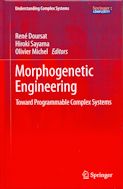
René Doursat, Hiroki Sayama, Olivier Michel.
Morphogenetic Engineering: towards programmable complex systems.
Springer. 2012

Generally, spontaneous pattern formation phenomena are random and repetitive, whereas elaborate devices are the deterministic product of human design.

Yet, biological organisms and collective insect constructions are exceptional examples of complex systems that are both self-organized and architectural.

This book is the first initiative of its kind toward establishing a new field of research, Morphogenetic Engineering, to explore the modeling and implementation of “self-architecturing” systems. Particular emphasis is placed on the programmability and computational abilities of self-organization, properties that are often underappreciated in complex systems science—while, conversely, the benefits of self-organization are often underappreciated in engineering methodologies.

Altogether, the aim of this work is to provide a framework for and examples of a larger class of “self-architecturing” systems, while addressing fundamental questions such as

• How do biological organisms carry out morphogenetic tasks so reliably?
• Can we extrapolate their self-formation capabilities to engineered systems?
• Can physical systems be endowed with information (or informational systems be embedded in physics) so as to create autonomous morphologies and functions?
• What are the core principles and best practices for the design and engineering of such morphogenetic systems?

The intended audience consists of researchers and graduate students who are working on, starting to work on, or interested in programmable self-organizing systems in a wide range of scientific fields, including computer science, robotics, bioengineering, control engineering, physics, theoretical biology, mathematics, and many others.