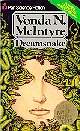
Snake is a healer in a post-apocalypse world. She has that name
because of her three serpents, genetically modified to produce medicines
and vaccines. Early on, she loses Grass, her Dreamsnake, due to a tragic
misunderstanding. Dreamsnakes are alien creatures, and in desperately
short supply, and Snake can't continue to be a full healer without one. So
the rest of the book follows her attempts to solve this problem.
The first chapter, where Snake loses Grass, is the much-anthologised
short story "Of Mist, and Grass, and Sand". That short story is
very good, but the novel is even better. We get to see more of the varied
post-apocalyptic world as Snake travels through it. Snake is a great
protagonist -- it would have been easy to make her a super-competent
saint, but instead she feels solidly real: competent in her profession,
caring in a pragmatic way, but also often tired, dirty, depressed, angry,
or scared. The minor characters are equally well-drawn and
distinguishable. And the background world, with its strange mix of low and
high-tech, and different cultures, feels like a real world, not just a
hotchpotch of scenes for Snake to travel through.
[One feature of the book I never noticed until a discussion on the
newsgroup rec.arts.sf.written concerns the character Meredith.
When I first read the book, I assumed Meredith to be male, because I think
of Meredith as a male name. However, I discovered that Meredith can also
be a female name. And there are no gender references to Meredith at all.
It is a fascinating exercise to read assuming one gender, then re-read
assuming the other.]
All too often a travel story can seem episodic; the protagonist travels
from scene to scene, and the past scenes seem to evaporate from the world.
Here, however, there is a second parallel strand to the story, which
manages to link the scenes together cleverly, so that you see a place
continuing to exist after Snake has left it. This technique helps to make
the world feel real.
Dreamsnake is one of the books I periodically re-read; it is
also one I dearly wish I could read again for the first time.