
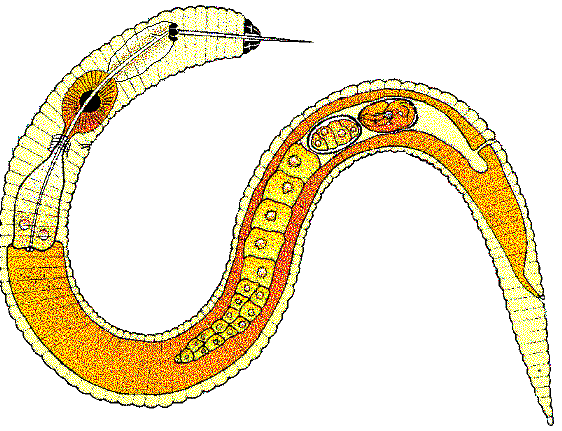
 Nematodes range in size from from about 300 microns to over 8
meters, although most are between 400 microns and 5mm. They are usually quite
simple organisms, consisting of an elongate stomach and reproduction system inside a resistant outer cuticle (for more details, click on the image on the
right). Their size, simplicity and ability to adapt have all contributed to their success as a a species.
Nematodes range in size from from about 300 microns to over 8
meters, although most are between 400 microns and 5mm. They are usually quite
simple organisms, consisting of an elongate stomach and reproduction system inside a resistant outer cuticle (for more details, click on the image on the
right). Their size, simplicity and ability to adapt have all contributed to their success as a a species.

One specific species of nematode, Phasmarhabditis hermaphrodita, is known to parasitise slugs and snails. It has been shown to kill the slugs D. reticulatum, Deroceras caruanae, Arion ater, Arion intermedius, Arion distinctus, Arion silvaticus, Tandonia sowerbyi and the snails Monacha cantiana, Lymnaea staggnalis, Helix aspersa, Theba pisana, Cernuella virggata, Cochlicella acuta. It does not seem to harm any other organisms, including other slug predators, although it does attack water snails.
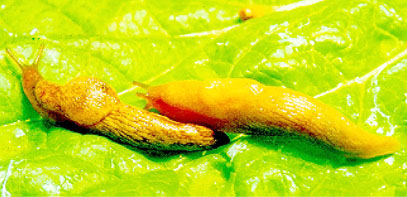 The third stage
dauer larvae (non-eating arrested juveniles) move through the soil searching for
slugs. Infection is typically through a natural opening at the rear of the slug's mantle. Upon infection these dauer larvae develop into self-fertilising
hermaphrodites and go through the process of reproduction. This causes a
swelling in the slug's mantle, and eventually death, whereupon the nematodes
spread out over the cadaver and feed (this occurs below the soil surface, since
the slugs move underground before they die). When the food source is depleted,
the nematodes once again form dauer larvae and leave in search of slugs. The
picture shows an infected slug (left) compared to a normal healthy adult
(right).
The third stage
dauer larvae (non-eating arrested juveniles) move through the soil searching for
slugs. Infection is typically through a natural opening at the rear of the slug's mantle. Upon infection these dauer larvae develop into self-fertilising
hermaphrodites and go through the process of reproduction. This causes a
swelling in the slug's mantle, and eventually death, whereupon the nematodes
spread out over the cadaver and feed (this occurs below the soil surface, since
the slugs move underground before they die). When the food source is depleted,
the nematodes once again form dauer larvae and leave in search of slugs. The
picture shows an infected slug (left) compared to a normal healthy adult
(right).
It should be noted that the pathogenicity of P. hermaphrodita is dependent on its association with certain bacteria, such as Moraxella osloensis and Pseudomonas fluorescens.
Such nematodes occur naturally in the soil (with their partner bacteria),
although not usually in the sufficient numbers to make a significant difference
to slug populations. It has been shown that if applied at a dose rate of 3E9 per hectare, nematodes gives control equivalent to better than
methiocarb pellets. To put these numbers in perspective, a package of nematodes
(very similar in size and shape to a "ready-meal" pack) used to treat for 25
sq.m. contains over 12 million nematodes. These are now produced commercially in
the UK by The MicroBio
Group (available to gardeners from Chase Organics., for example).
It has been
shownNematode treatment lasts longer than methiocarb pellet treatment (still
significant after 6 weeks, although treatment may fail to be significant after
27 weeks). Research has shown that nematodes deal with slugs in a number of highly desirable ways. Slugs tend to avoid soil treated by nematodes, and are
less likely to rest there. Another benefit is that infected slugs tend to stop
eating long before they actually die.
Nematology encompasses a large field of research, with much work on control
nematode bests (some of which attack plants, animals and humans) as well as exploiting beneficial ones. Below are just some of the Nematode Sites
online. Please feel free to contact
us if there are any sites you think should be added.
Institute of Agriculture and Natural Resources, University of Nebraska. A site designed as an aid for nematode identification and systematic research, as well as a general resource for the science of Nematology.
Biological control, Cornel University. Includes specific details on P. hermaphrodita.
Alternative Nematode Control from the ATTRA (Appropriate Technology Transfer for Rural Areas).
Defenders Ltd. A variety of natural pest controls for gardeners are available, including "Slugsure".
Chase Organics. Organic gardening catalogue from HDRA, including "Nemaslug".
MicroBio Group, who develop and market biofertilisers and biopesticides for crop production. A variety of natural pest controls for commercial agriculture and horticulture are available, including "Nemaslug".