
Ultrafast magnetism
Magnetic data are written today using the magnetic field of a tiny electromagnet, a process which takes around a nanosecond. In 1996 it was discovered that a femtosecond laser pulse could demagnetise nickel in less than a picosecond, far faster than had been thought possible, and since then the field of ultrafast magnetism has sought to understand how, and how quickly, magnetic order can be controlled with light. The prospect is of writing information many times faster and with far less energy than conventional methods. However, on these timescales the usual description of a magnet in terms of a single, smoothly varying magnetisation breaks down, since the spins on individual atoms are driven far out of equilibrium with each other and with the lattice. Atomistic spin models, which treat every atomic spin separately and include the heating of the electrons by the laser, are therefore an essential tool for understanding what happens.
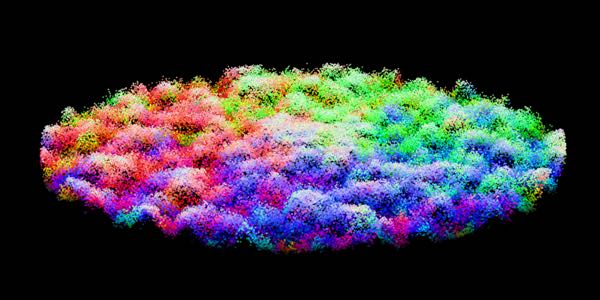
Simulated spin configuration of a thin magnetic disc in a strongly disordered state, where the colour indicates the local direction of the atomic spins. On ultrafast timescales the magnetisation cannot be described by a single vector, which is why an atomistic description is needed.
All-optical switching in ferrimagnets
Our starting point is the ferrimagnetic alloy GdFeCo, in which the Gd and Fe moments are coupled antiparallel. Working with experimental colleagues in Nijmegen and Berlin, we combined element-specific X-ray measurements with our atomistic model and found that after a femtosecond laser pulse the Gd and Fe sublattices demagnetise at very different rates. The reversal then proceeds through a transient ferromagnetic-like state in which both sublattices point the same way, with the Gd sublattice reversing within 1.5 ps [1]. What is interesting is that no magnetic field is needed at all. We showed numerically, and our collaborators demonstrated experimentally, that heating alone by a sub-picosecond laser pulse is sufficient to reverse the magnetisation deterministically [2]. This overturned the long-held assumption that heat, which has no direction, could at most assist magnetisation reversal. We then showed that switching requires angular momentum to be transferred from the longitudinal to the transverse magnetisation components of the transition metal, from where it passes to the rare earth [3].
These insights allowed us to predict switching in other materials. We showed that synthetic ferrimagnets, built from two antiferromagnetically coupled magnetic layers, can be switched by a single laser pulse in a similar way to ferrimagnetic alloys, and identified the material properties needed for this, demonstrating their potential as high density storage elements that need no write field [4]. We have since studied the role of element-specific damping in all-optical switching of (Gd,Tb)Co films [5], and found that the recovery of magnetic order after laser excitation proceeds through the localisation and coalescence of magnons, driven by large exchange-mediated spin currents [6]. In Co/Pt multilayers with nanoscale domains, combined experiments and simulations showed that ultrafast demagnetisation is dominated by the local dissipation of angular momentum, with spin transport between domains playing only a minor role [7]. In addition, ultrafast suppression of the interlayer exchange coupling in synthetic antiferromagnets can induce a transient ferromagnetic state [8].
Towards all-optical recording
The ultimate goal is to use light to write data in a hard disk. We have assessed how all-optical switching could provide a path to recording technologies beyond heat-assisted magnetic recording [9], and this is now the central aim of the DREAMS project, which uses laser-generated spin currents to make switching deterministic in recording media. However, ultrafast switching to date has been predominantly thermally driven, and the excess heat limits its energy efficiency. Using spin-lattice dynamics simulations, we showed that exciting phonons with terahertz radiation can trigger coherent switching of an insulating magnet, providing a route to minimally dissipative ultrafast switching [10]. Our work on antiferromagnets extends these ideas to the optical control of materials with no net magnetisation.
Spin dynamics at high temperatures
Describing these processes accurately demands better theoretical models. We developed a stochastic form of the Landau-Lifshitz-Bloch equation, a description of magnetisation dynamics valid at all temperatures, which unlike previous forms is consistent with the Boltzmann distribution close to the Curie temperature [11]. To capture the flow of energy and angular momentum between the spins and the crystal lattice, we developed a unified spin-lattice dynamics model in which the damping follows from a coupling term representing the spin-orbit interaction [12]. Most recently we have included quantum effects in atomistic spin dynamics through coloured noise derived from quantum mechanics, giving excellent quantitative agreement with experimental magnetisation curves for nickel and gadolinium across the full temperature range [13]. These models give an increasingly quantitative, atom-by-atom description of how light controls magnetism, which is the basis for designing ultrafast and energy-efficient magnetic data storage.
Related publications
[1] Radu et al, Transient ferromagnetic-like state mediating ultrafast reversal of antiferro magnetically coupled spins, Nature 472, 205-208 (2011) 
[2] Ostler et al, Ultrafast heating as a sufficient stimulus for magnetization reversal in a ferrimagnet, Nature Communications 3, 666 (2012)
[3] Atxitia et al, Ultrafast dynamical path for the switching of a ferrimagnet after femtosecond heating, Phys. Rev. B 87, 224417 (2013)
[4] Evans et al, Ultrafast thermally induced magnetic switching in synthetic ferrimagnets, Applied Physics Letters 104, 082410 (2014)
[5] Ceballos et al, Role of element-specific damping in ultrafast, helicity-independent, all-optical switching dynamics in amorphous (Gd,Tb)Co thin films, Physical Review B 103 024438 (2021)
[6] Iacocca et al, Spin-current-mediated rapid magnon localisation and coalescence after ultrafast optical pumping of ferrimagnetic alloys, Nature Communications 10, 1756 (2019)
[7] Zhang et al, The indispensable role of the local mechanism in laser induced demagnetization of Co/Pt multilayers with nanoscale magnetic domains, Nanotechnology 29 275703 (2018)
[8] Li et al, Transient ferromagnetic state induced by ultrafast suppression of interlayer exchange coupling in synthetic antiferromagnets, APL Materials 14 071105 (2026)
[9] Strungaru et al, All-Optical Switching: A Path to Recording Technology Beyond HAMR, IEEE Transactions on Magnetics 61 1-9 (2025)
[10] Strungaru et al, A route to minimally dissipative switching in magnets via THz phonon pumping, Physical Review B 109 224412 (2024)
[11] Evans et al, Stochastic form of the Landau-Lifshitz-Bloch equation, Phys. Rev. B 85, 014433 (2012)
[12] Strungaru et al, Spin-lattice dynamics model with angular momentum transfer for canonical and microcanonical ensembles, Physical Review B 103 024429 (2021)
[13] Weber et al, Atomistic spin dynamics with quantum colored noise, Physical Review B 113 064423 (2026)


