Study
Kit
–
Improving Exam
Results
How
can
I
improve
my exam results?
 Whether
you’ve failed your exams this time, whether you just know
you
can do better next time, or whether you're planning to make
sure you
pass, there are a number of strategies that have been shown
to be
very effective. All of them involve some extra work, so this
is why
we have also included sections on managing your time more
effectively
(see sections on Planning
and Diaries).
Whether
you’ve failed your exams this time, whether you just know
you
can do better next time, or whether you're planning to make
sure you
pass, there are a number of strategies that have been shown
to be
very effective. All of them involve some extra work, so this
is why
we have also included sections on managing your time more
effectively
(see sections on Planning
and Diaries).
The
five following points will help you to maximize the benefit you
get
from each course. If you’re running short of time, or feel
overwhelmed by all of this – just try one of the
following for now, and see how you get on. The important thing
is to
try something different/new.
Make
full use of lectures
Engage
with
the on-line material for each course
Read
the
recommended texts
Do
the tutorial examples
Read
&
do Past Papers
Make
full
use
of
lectures
 Make
sure you attend all lectures, labs and workshops. It
might
seem obvious but there is a strong correlation between
attendance and
exam performance.
Make
sure you attend all lectures, labs and workshops. It
might
seem obvious but there is a strong correlation between
attendance and
exam performance.
Put
the details from current timetable (All
timetables) in your diary or planner (Why
should I use a diary / planner?)
Make
time to look through your lecture notes after the
lecture.
Fill
in any gaps by referring
to
the
recommended
books or by working
with
someone
else
Many people recommend writing them out again
in
an improved and more succinct form.
If
you’re not happy with your own notes, try these ideas to
improve
your
note-taking
skills or explore the use
of mind-maps to take notes.
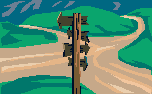 Think
of the lectures as signposts
– showing
you what needs to be learned, and introducing the
material. But
like signposts in real life, just looking
at
them does not get you where you want to go – you need to
take
action to get there.
Think
of the lectures as signposts
– showing
you what needs to be learned, and introducing the
material. But
like signposts in real life, just looking
at
them does not get you where you want to go – you need to
take
action to get there.
Engage
with
the
on-line
material for each course
 Most
of your courses have some material on-line to help you
study.
Most
of your courses have some material on-line to help you
study.
Take
a look now at the List of Courses with on-line material (BSc
Year
1, BEng/MEng
Year
1).
As
an example, let’s look in more detail at the material
available
from two lecturers: Tony Tew’s first year digital material,
and
John Dawson’s Circuits material within the module Introduction
to
Electronic
Hardware.
The
Digital
material is held on the Electronics computer server,
and
contains:
·
Handouts
and Lecture Schedule
·
Questions
sheets
and
Past Papers (worked solutions are added as the course
progresses)
·
Digital
Jokes
and
Cartoons!
For
the Circuits material, please visit the main Circuits
page on the Virtual
Learning
Environment (VLE) to get an idea on what is available
to you.
Log
into the vle,
Under Modules and the list of Courses in which you are enrolled
click
on Introduction to Electronic Hardware
In the left-hand Menu, click
on
Circuits
This
includes:
·
A
full set of very detailed Course
Notes – make
sure you read
these
and
use
them
to supplement your own notes.
·
A
list of Recommended
Books for
this course. Includes an on-line version of “Introductory
Circuit
Theory”
by
Kel Fidler.
·
A
set of Interactive
Tutorials where
you can get instant feedback, and then see the answers
·
Further
Problem
Sheets and
worked examples
·
Past
exam papers and
some worked solutions for Circuits questions
·
Recommended
links
to helpful on-line material
If, for some reason
you
have not got VLE access, you can access some of the material
(handouts
etc.) here.
So,
there is a wealth of material here, but you will need to organise
yourself
and
your
time to work through it.
Read
the
recommended
texts
 It
always helps to read another author’s perspective on the
topics
you are learning. In this way you can cover material that
may not be
clear to you in the lectures. One of the most important
things you
can do is to read around the subject. On University
Challenge
you may notice that people say that they are “reading
electronics” – not “just sitting in electronics
lectures” or worse still “sleeping in late”, which
may of course be more honest.
It
always helps to read another author’s perspective on the
topics
you are learning. In this way you can cover material that
may not be
clear to you in the lectures. One of the most important
things you
can do is to read around the subject. On University
Challenge
you may notice that people say that they are “reading
electronics” – not “just sitting in electronics
lectures” or worse still “sleeping in late”, which
may of course be more honest.
What
books should I read?
Your
lecturer
may
have
already recommended some reading material, or it might
be listed on the internal course-pages (see above).
You
will always find them in the Syllabus (Click on the Syllabus
links on
the pages for Year
1
BSc and here for Year
1
B/MEng), at the end of the entry for each lecture
course. We talk
more about the Syllabus in the section called Exactly
what
am
I
meant to be studying?, but for now – scroll
through the document and note that the courses are arranged
alphabetically.
Again,
with the pressures of study you’ll need to organise
your
time, so that you make the most of the course books.
Do
the
tutorial
examples
 Lecturers
provide tutorial examples because you need to practice
working
out the material for yourself – otherwise it will be a severe
shock when you reach exam time. Think of tutorials as mini mock
exams
that also help you learn how to manipulate the stuff you are
learning
in the lectures.
Lecturers
provide tutorial examples because you need to practice
working
out the material for yourself – otherwise it will be a severe
shock when you reach exam time. Think of tutorials as mini mock
exams
that also help you learn how to manipulate the stuff you are
learning
in the lectures.
You
can find tutorial examples in the On-line
material
for
each
module.
But
you may also be sent sheets by email, or have them handed out in
lectures.
Read
&
do
Past
Papers
 Previous
exam papers are made available for you to practice
your
exam
technique ahead
of time. For BEng/MEng students the First
Year
Assessment
pages hold lots of information about
assessment.
Previous
exam papers are made available for you to practice
your
exam
technique ahead
of time. For BEng/MEng students the First
Year
Assessment
pages hold lots of information about
assessment.
Towards the end of these pages you will find Past
Papers e.g. Last
year’s exam papers.
(For
BSc
students
there are fewer exams in the first year, but more as you
go through the course. BSc
assessment
pages
are
here).
You
should work through these, and note the places where you get
stuck.
Many people get stuck, then immediately get dispirited and
give up.
Instead, treat getting
stuck as
your own personal ‘signpost’ to what you need to study
more.
Re-read your lecture notes on this section
See what the recommended books have to say
Revisit your tutorial examples
Talk to fellow students about the exam questions
and the
topics
In
other words – practice the hard bits!
Study
Kit navigation: Home;
Exams;
Studying
together; Problems;
Curriculum;
Assessment;
Planning;
Diaries.