Books

Short works

Books : reviews

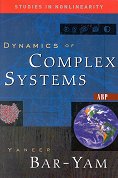
Yaneer Bar-Yam.
Dynamics of Complex Systems.
Perseus Books. 1997

The study of complex systems in a unified framework has become recognized in recent years as a new scientific discipline, the ultimate in the interdisciplinary fields. Breaking down the barriers among physics, chemistry, and biology, and the so-called soft sciences of psychology, sociology, economics, and anthropology, this text explores the universal physical and mathematical principles that govern the emergence of complex systems from simple components. The book is designed for upper-undergraduate/beginning graduate level students, and covers a broad range of applications in a broad array of disciplines. A central goal of this text is to develop models and modeling techniques that are useful when applied to all complex systems. Chapters open with conceptual outlines and close with detailed questions, problems, and worked-out solutions.
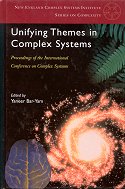
Yaneer Bar-Yam, ed.
Unifying Themes in Complex Systems: proceedings of the first International Conference on Complex Systems, New Hampshire, 1997.
Perseus Books. 2000

Contents

• Herbert A. Simon. Can there be a science of complex systems?. 2000
• Richard C. Lewontin. Evolution. 2000
• Charles Cantor. Genome complexity (session introduction: emergence). 2000
• Daniel Keyser. Emergent properties and behavior of the atmosphere. 2000
• Dan McShea. A Hypothesis about networks. 2000
• Richard C. Strohman. Session introduction: informatics. 2000
• Temple Smith. Whole genome bioinformatics. 2000
• Bruce M. Boghosian. Session introduction: computational methods. 2000
• Petra Ahrweiler. Theories in (inter)action: a complex dynamic system for theory evaluation in Science Studies. 2000
• Olympia Lilly Bakalis. Modeling fractal patterns with Genetic Algorithm solutions to a variant of the inverse problem for Iterated Function Systems (IFS). 2000
• Raffaele Calabretta, Stefano Nolfi, Domenico Parisi, Gunter P. Wagner. An Artificial life model for investigating the evolution of modularity. 2000
• Bart De Boeck, Paul Scheunders, Dirk Van Dyck. From inductive inference to the fundamental equation of measurement. 2000
• Michael Doebeli. Controlling chaos in systems with coupled maps with long-range interactions. 2000
• Javier Dolado, Alvaro Moreno. Assessing software organizations from a complex systems perspective. 2000
• Keith Donnelly. Hazards, self-organization, and risk compensation: A view of life at the edge. 2000
• Udo Erdmann. Structure formation by Active Brownian particles with nonlinear friction. 2000
• David A. Fell. Systems properties of metabolic networks. 2000
• Christian V. Forst. Complex dynamics of molecular evolutionary processes. 2000
• Stefanie Fuhrman, Xiling Wen, George S. Michaels, Roland Somogyi. Genetic network inference. 2000
• M. Giampietro, K. Mayumi, G. Pastore. Socioeconomic systems as complex self-organizing adaptive holarchies: The dynamic exergy budget. 2000
• M. Giampietro, K. Mayumi, G. Pastore. Socioeconomic systems as nested dissipative adaptive systems (holarchies) and the dynamic energy budget: Validation of the approach. 2000
• Jeffrey A. Goldstein. Psychology and corporations: A complex systems perspective. 2000
• Hyman Hartman. Symmetry breaking and the origin of life. 2000
• Piet Hut, Brian C. Goodwin, Stuart A. Kauffman. Complexity and funtionality: A search for the where, the when, and the how. 2000
• Donald E. Ingber. Biological design principles that guide self-organization, emergence, and hierarchical assembly: From complexity to tensegrity. 2000
• Mariusz H. Jakubowski, Ken Steiglitz, Richard Squier. Information transfer between solitary waves in the saturable Schrodinger equation. 2000
• Brian D. Josephson. An Integrated theory of nervous ssytem functioning embracing nativism and constructivism. 2000
• David M. Keirsey. Towards the physics of "death". 2000
• Francisco Louca. Ragnar Frisch at the edge of chaos. 2000
• Philip Mayim. Programming complex systems. 2000
• David A. Meyer. Towards the global: Complexity, topology and chaos in modelling, simulation and computation. 2000
• Jason G. Mezey, Gunter P. Wagner. An Effect of scale in a non-additive genetic model. 2000
• Kenneth J. Moriarty, Jonathan L. Machta, Raymond Greenlaw. Parallel compuational complexity in statistical physics. 2000
• Mark E. J. Newman. Statistical methods of mass extinction. 2000
• Danko Nikolic. A Dual processing theory of brain and mind: Where is the limited processing capacity coming from?. 2000
• Helge Rose. Evolutionary strategies of optimization and the complexity of fitness landscapes. 2000
• Kazuhiro Saitou. Conformational switching as assembly instructions in self-assembling mechanical systems. 2000
• Jeffrey C. Schank, Jeff Alberts. Aggregation and the emergence of social behavior in rat pups modeled by simple rules of individual behavior. 2000
• Bernhard Sendhoff, Clemens Potter, Werner von Seelen. The Role of information in simulated evolution. 2000
• Richard Smith, Mark A. Bedau. Emergence of complex ecologies in ECHO. 2000
• Robin Snyder. Spatial correlations in the contact process: A step toward better ecological models. 2000
• Roland Somogyi. Many to one mappings as a basis for life. 2000
• Didier Sornette. Generic mechanisms for hierarchies. 2000
• Didier Sornette. Emergence in earthquakes. 2000
• Yasuhiro Suzuki, Hiroshi Tanaka. Chemical oscillation in symbolic chemical system and its behavioral pattern. 2000
• Kei Tokita, Ayumu Yasutomi. Extinction dynamics in a large ecological system with random interspecies interactions. 2000
• Irina Trofimova. Functional differentiation in developmental sytems. 2000
• Tsang Ing Jyh, Tsang Ing Ren. Tuning complexity on randomly occupied lattices. 2000
• James G. Uber, Ali A. Minai. Socioeconomic organization on directional resource landscapes. 2000
• Alexander Yu. Vlasov. "Continuous time" in Feigenbaum's model. 2000
• Lipo Wang. Ordering chaos in a neural network with linear feedback. 2000
• Peter Wills, Leah Henderson. Self-organisation and information-carrying capacity of collectively autocatalytic sets of polymers: Ligation systems. 2000
• David H. Wolpert, WIlliam G. Macready. Self-dissimilarity: An empirically observable complexity measure. 2000
• Gad Yagil. Complexity and order in chemical and biological systems. 2000

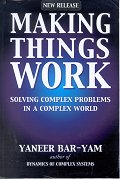
Yaneer Bar-Yam.
Making Things Work: solving complex problems in a complex world.
Knowledge Press. 2004

Why does the U.S. continue to lose 50,000-100,000 people each year to medical errors despite rigorous physician training and advanced technology? How could the U.S. government have spent over $3 billion in a project to redesign the Air Traffic Control System without even replacing a single part? Why do billions of dollars in assistance fail to promote development in third-world countries? Why is the U.S. military challenged by a handful of terrorists? Why are we so unhappy with our education system?

More importantly: How can we fix these problems?

Making Things Work describes how complex systems concepts can help in solving the complex problems facing us today. In easy to understand language, this book explains how effectively organizing people can solve complex problems in:

• healthcare • education • military conflict • ethnic violence and terrorism • third world development

When a problem is highly complex one person cannot solve it alone, but organizations of people can, if they know how to work together. Making Things Work explains why traditional organizations and traditional forms of control and planning are not effective for addressing these tasks. It draws on basic insights from complex systems research emergence, complexity, patterns, networks and evolution to explain how effective teams form through cooperation and competition, and how to make non-hierarchical organizations effective at their tasks.

Everyone can take away something from the practical and instructive problem-solving approach described in this book.

Yaneer Bar-Yam, Ali A. Minai, eds.
Unifying Themes in Complex Systems II: proceedings of the second International Conference on Complex Systems, 1998.
Perseus Books. 2004

Contents

• Daniel L. Stein, Charles R. Doering, Geoffrey B. West, Cristopher Moore, Matt Wilson, H. Fred Nijhout. Pedagogical sessions. 2004
(transcript)
• Jeffrey Robbins, Richard W. Wrangham. Reception session. 2004
(transcript)
• Yaneer Bar-Yam, Philip W. Anderson, Stephen M. Kosslyn, Norman I. Badler, David Sloan Wilson. Emergence. 2004
(transcript)
• J. Stephen Lansing, John D. Sterman, David Harel, Richard G. Palmer, Gerald Jay Sussman. Description and Modeling. 2004
(transcript)
• David Litster, James Anderson, Mike McCloskey. Funding. 2004
(transcript)
• Dean LeBaron. Complex understanding of today's global economics. 2004
(extended abstract)
• William Fulkerson, Robert Axtell, Abhijit Deshmukh, H. Van Dyke Parunak, Win Farrell. Agents in action. 2004
(transcript)
• Tom Petzinger, William McKlevey, Peter Senge, Laurence Prusak, Hentry Mintzberg, Ron Schultz. Complexity and management. 2004
(transcript)
• Paul Halpern. Evolutionary algorithms on a self-organized dynamic lattice. 2004
• J. Yasher Kresh, Igor Izrailtyan, Andrew S. Wechsler. The heart as a complex adaptive system. 2004
• H. Van Dyke Parunak. The DASCh experience: how to model a supply chain. 2004
• Jerzy Maselko, Michael Anderson. Some properties of multicelluar chemical systems: response to the environment and emergence. 2004
• Wolfgang Banzhaf, Dirk Banscherus, Peter Dittrich. Hierarchical genetic programming using local modules. 2004
• Hernan Lopez Garay, Joaquin Contreras. Dealing with complex human systems from an interpretive systemic perspective. 2004
• Uri Wilensky, Kenneth Reisman. Connected science: learning biology through constructing and testing computational theories. 2004
• Ron Cottam, Willy Ranson, Roger Vounckx. Diffuse rationality in complex systems. 2004
• Hiroki Sayama. Spontaneous evolution of self-reproducing loops on cellular automata. 2004
• Sui Huang, Donald E. Ingber. Regulation of cell cycle and gene activity patterns by cell shape: evidence for attractors in real regulatory networks and the selective mode of cellular control. 2004
• Jay Bancroft. A model system and individual-based simulation for developing statistical techniques and hypotheses for population dynamics in fragmented populations. 2004
• Jeffrey C. Schank. A new paradigm for evolutionary psychology: animal social systems as complex adaptive systems. 2004
• Carlo C. Maley. Comparing causal factors in the diversification of species. 2004
• Craig R. Zimmermann, Tadashi Fukami, James A. Drake. An experimentally-derived map of community assembly space. 2004
• Kai Nagel, Richard L. Beckman, Christopher L. Barrett. TRANSIMS for transportation planning. 2004
• Cirrus Shakeri, David C. Brown. Mapping multi-disciplinary design processes. 2004
• Gottfried J. Mayer-Kress, Karl M. Newell, Yeou-Teh Liu. What can we learn from learning curves?. 2004
• Holger Lange. Time series analysis of ecosystem variables with complexity measures. 2004
• Robert Savit, Radu Manuca, Yi Li, Rick L. Riolo. The dynamics of minority competition. 2004
• Dimitris Stassinopolous, Silvano P. Colombano, Jason D. Lohn, Gary L. Haith, Jeffrey Scargle, Shoudan Liang. Spatial autocatalytic dynamics: an approach to modeling prebiotic evolution. 2004
• Francesco Santini, Lodovico Galleni, Paola Cerrai. Geophysiological modeling: a new approach at modeling the evolution of ecosystems. 2004
• Paul W. Morris. Organizational Intelligence. 2004
• Robert M. Cutler. The complex evolution of international orders and the current international transition. 2004
• Leticia Aviles. Cooperation, nonlinear dynamics and the levels of selection. 2004
• Andre J. van der Kouwe, Richard C. Burgess. Examining the dynamics of a vector representing neurophysiological state during intensive care. 2004
• Bennett Levitan, Jose Lobo, Richard Schuler, Stuart A. Kauffman. Optimal organizational size in the presence of externalities. 2004
• Michael J. Jacobson, Win Farrell, Kenneth Brecher, Jim Kaput, Marshall Clemens, Uri Wilensky. Education in complex systems. 2004
• Vasant Honavar, Leslie Miller, Johnny Wong. Distributed knowledge networks. 2004
• David A. Meyer. Complexity of allocation processes: chaos and path dependence. 2004
• Tim Middelkoop, Abhijit Deshmukh. Caution! Agent based systems in operation. 2004
• Dirk Holste, Hanspeter Herzel, Ivo Grosse. Entropy estimation from finite samples. 2004
• Christina Stoica, Jurgen Kluver, Jorn Schmidt. In the looking glass: the self modeling of social systems. 2004
• Jim Hines, Jody House. Harnessing evolution for organizational management. 2004