Murray Gell-Mann.
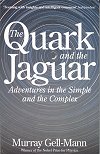
The Quark and the Jaguar.
Abacus. 1994
rating : 2.5 : great stuff
review : 14 January 2001
A brilliant and vastly irritating book. Brilliant because it covers a wide range of fascinating subjects, with many intriguing new insights. Irritating because it never seems to go into sufficient depth about any of them.
The book covers two main topics, and tries to integrate them. The section on quantum mechanics and fundamental particles -- Gell-Mann's original background -- has some fascinating stuff on the modern "many alternative histories" interpretation of QM, coarse-graining and entropy, and the link to the quasi-classical domain. All gripping stuff, and worth a whole (popular) book of their own. Then the section on Complex Adaptive Systems -- based on Gell-Mann's more recent work at the Santa Fe Institute, has lots of equally fascinating insights into evolution, information, complexity, chaos, self-organisation, adaptation, and so on. But again, tons of interesting ideas are each compressed into a sentence or two. The text is split, under headings, into half-page or one-page fragments, each of which could usefully be expanded almost to chapter length in order to discuss fully the points Gell-Mann mentions in passing.
The Afterword, announced as a kind of "executive summary" (so why wasn't it at the beginning?), compresses further the entire book into nine breathlessly dense pages. However, I felt that the entire book acted as an executive summary to the book(s) I really want to read. Gell-Mann admits that the book "reaches into a large number of areas it cannot explore thoroughly or in depth" -- indeed, many of those areas are still subjects of active research -- and that its purpose is "to stimulate thought and discussion" -- it certainly does that, but a Further Reading section would have been a welcome addition.
Contents includes:
- Kinds of complexity
- computational complexity -- how the time taken for a computer program to run varies with the size of the problem
- algorithmic information content -- (Greg Chaitin) how much a bit stream can be compressed -- the minimum length of a description of the string (so at a maximum when the string is its own minimum description, that is, incompressible, or random)
- effective complexity -- (a system has a regular and a random component) the length of the description used to describe the regularities -- hence completely regular and completely random systems both have very small effective complexity
- depth -- (Charles Bennett) how laborious it is to go from the highly compressed description to a fully-unwound description of a system (which is why we tend to use less-deep, partially-unwound, more efficient descriptions -- we don't always go back to "first principles")
- crypticity -- (Charles Bennett) how laborious it is to go from a fully-unwound description to a highly compressed description of a system
- Kinds of randomness
- incompressible: a random bit string is incompressible -- it has maximum algorithmic information content
- stochastic: produced by a chance process, such as tossing a fair coin -- most stochastic streams will be random(1) but occasionally, by chance, some will not (a chance long run of heads, for example)
- pseudo-random: produced by a deterministic computational process, but so complicated as to be effectively unpredictable, and to appear to simulate a stochastic process
- A more fundamental science has less "special information" in it. Chemistry is less fundamental than physics, because it applies only at temperatures where atoms exist, and you have to ask "chemistry-type" questions of it. Biology is a lot less fundamental than chemistry, because it has all the special information of contingent evolution on this planet in it. Less fundamental sciences are more complex sciences; many of their regularities arise from the special information, as well as from fundamental laws. Reductionism focuses on the fundamental laws, not the special information.
- quantum mechanics
- bosons (photons, gravitons, etc) "condense" and build up high densities, so can behave almost like classical fields (electromagnetism, gravity, respectively) -- fermions (electrons, etc) "exclude"; they can be described in terms of fields, but such fields never behave classically
- modern view is based on Hugh Everett's "many worlds" interpretation -- although better called "many alternative histories" -- not on "observers" and "collapsing wavefunctions"
- coarse-grained histories and decoherence; correlation with the quasi-classical domain -- fine-grained histories and interference, like the two slit experiment
- "quark" is pronounced "kwork" -- the line Three quarks for Muster Mark from Finnegans Wake, that suggests the pronunciation "kwark", was discovered later.
- pruning the history tree of probabilities when something is correlated with the quasi-classical domain, in other words "observed" to be a fact, is like pruning a probability tree when a coin is "observed" to be heads or tails -- nothing to do with collapsing wavefunctions
- Schrodinger's red herring -- the quantum event is amplified and correlated with the quasi-classical domain, that is, it becomes a fact -- so the cat really is either alive or dead -- there is no quantum interference of two cat states
- individuality perceived when each member of a set needs more bits to describe it than are needed to enumerate the set -- 6 billion people are individuals, each needing more than 32 each bits to describe them -- 100 billion stars in the galaxy are not all that individual, to us, at the current level of detail of our observation
- maximal quasi-classical domain -- the most detail the universe can be described in without getting quantum interference -- such a description need not be unique -- if one particular description gives rise to regularities, a complex adaptive system can arise to "compress" those regularities -- a CAS that arises to compress the regularities of a different quasi-classical domain description might not be able to perceive the regularities of the first: "goblin worlds"
- time and entropy -- time's arrow from the very special initial condition of the universe -- algorithmic information content also contributes to entropy
- gateway event: an increase in complexity leads to possibility of further huge increases in kinds and levels of complexity -- eukaryotes -- multi-celled organisms -- a new technology can be an economic gateway event
- CASs recognise regularities
- superstition: recognising a regularity that is not there -- denial: refusing to recognise one that is there
- art can recognise patterns not of interest to science, such as metaphors
- how can we achieve the spiritual satisfaction, comfort, social cohesion, great art, that accompany mythical beliefs, without having to believe the myths? -- how can we achieve cultural diversity without parochialism and ethnic conflict?
- there is no such thing as paranormal: if something weird really does occur, the relevant scientific laws will get changed or updated, as they were for continental drift, for meteorites, ...
- reasons for maladaption -- other selection pressures, frozen accidents and windows of maturation, differing timescales
- computer simulation of CASs
- biologically inspired neural nets, genetic algorithms -- what is the computer equivalent of the CAS human immune system?
- emergence of complex behaviour from simple rules: the rules imply general regularities, plus individual special regularities -- Thomas Ray's TIERRA: complex evolutionary behaviour from the beginning -- more realistic economics: bounded rationality, learning, inclusion of hard-to-quantify values
- physics: 1st law of thermodynamics, conservation of energy; economics, keeping track of money -- physics 2nd law: increase of entropy; what is the economic analog of irreversibility?
- Synthesis, integration and review are skills as important as finding new knowledge, but are not equally rewarded