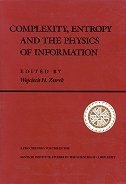
Wojciech H. Zurek, ed.
Complexity, Entropy and the Physics of Information.
Addison Wesley. 1990
Thermodynamics, statistical mechanics, the quantum theory of measurement,
the physics of computation and many of the issues of the theory of dynamical systems,
molecular biology, genetics, and computer science share information as a common theme.
This proceedings volume explores the connections among quantum and classical physics,
information and its transfer, and computation,
and the significance of these connections for the formulation of physical theories.
It also considers the origins and evolution of the information-processing entities,
their complexity, and the manner in which they analyze
their perceptions to form models of the Universe.
Based on a meeting held in Santa Fe, New Mexico sponsored by the Santa Fe Institute, this book will appeal to anyone interested in the connections among physical laws, the theory of computation and complexity, and the role played by information and its transfer in the Universe.
The papers are gathered under the following headings: • Physics of Information • Laws of Physics and Laws of Computation • Complexity and Evolution • Physics of Computation • Probability, Entropy, and Quantum • Physics of Information • Quantum Theory and Measurement
Contents
- • Complexity, Entropy and the Physics of Information---a Manifesto. 1990
- • John Archibald Wheeler. Information, Physics, Quantum: The Search for Links. 1989
- • Benjamin Schumacher. Information from Quantum Measurements. 1990
- • William K. Wootters. Local Accessibility of Quantum States. 1990
- • V. F. Mukhanov. The Entropy of Black Holes. 1990
- • Shin Takagi. Some Simple Consequences of the Loss of Information in a Spacetime with a Horizon. 1990
- • Paul C. W. Davies. Why is the Physical World so Comprehensible?. 1990
- • Algorithmic Information Content, Church-Turing Thesis, Physical Entropy, and Maxwell's Demon. 1990
- • Carlton M. Caves. Entropy and Information: How Much Information is Needed to Assign a Probability?. 1990
- • J. Rissanen. Complexity of Models. 1990
- • C. H. Woo. Laws and Boundary Conditions. 1990
- • Charles H. Bennett. How to define complexity in physics, and why. 1990
- • Stuart A. Kauffman. Requirements for Evolvability in Complex Systems: Orderly Dynamics and Frozen Components. 1990
- • Seth Lloyd. Valuable Information. 1990
- • Dilip K. Kondepudi. Non-Equilibrium Polymers, Entropy, and Algorithmic Information. 1990
- • Tad Hogg. The Dynamics of Complex Computational Systems. 1990
- • James P. Crutchfield, Karl Young. Computation at the Onset of Chaos. 1990
- • Norman H. Margolus. Parallel quantum computation. 1990
- • W. G. Teich, G. Mahler. Information Processing at the Molecular Level: Possible Realizations and Physical Constraints. 1990
- • Tommaso Toffoli. How Cheap Can Mechanics' First Principles Be?. 1990
- • Xiao-Jing Wang. Intermittent Fluctuations and Complexity. 1990
- • A. Zee. Information Processing in Visual Perception. 1990
- • Asher Peres. Thermodynamic Constraints on Quantum Axioms. 1990
- • M. Hossein Partovi. Entropy and Quantum Mechanics. 1990
- • Otto E. Rossler. Einstein Completion of Quantum Mechanics Made Falsifiable. 1990
- • J. W. Barrett. Quantum Mechanics and Algorithmic Complexity. 1990
- • E. T. Jaynes. Probability in Quantum Theory. 1990
- • H. Dieter Zeh. Quantum Measurements and Entropy. 1990
- • Murray Gell-Mann, James B. Hartle. Quantum Mechanics in the Light of Quantum Cosmology. 1990
- • Jonathan J. Halliwell. Information Dissipation in Quantum Cosmology and the Emergence of Classical Spacetime. 1990
- • David Z. Albert. The Quantum Mechanics of Self-Measurement. 1990
- • L. A. Khalfin. The Quantum-Classical Correspondence in Light of Classical Bell's and Quantum Tsirelson's Inequalities. 1990
- • Roland Omnes. Some Progress in Measurement Theory: The Logical Interpretation of Quantum Mechanics. 1990