Books

Short works

Books : reviews

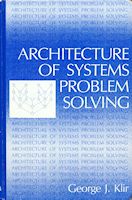
George J. Klir.
Architecture of Systems Problem Solving.
Plenum. 1985

Professor Klir presents a conceptual framework through which comprehensive taxonomies of systems and systems problems are formulated, along with representative methods for dealing with the individual classes of problems. A unique feature of the book is that the concepts, problems, and methods are introduced in the context of an architectural formulation of an expert system – the general system problem solver (GSPS) – designed to provide users of all kinds with computer-based knowledge and methodology. The skeleton of the CSPS taxonomy of systems is a hierarchy of epistemological types of systems. This epistemological hierarchy – a key concept in systems science – makes it possible to capture the infinite variety of systems problems by a finite and rather small number of problem categories.

Architecture of Systems Problem Solving is suitable as a textbook for a variety of courses dealing with fundamental systems concepts, major categories of systems problems, and selected methods for dealing with these problems at the first-year graduate or upper division undergraduate level. The book is also intended for practicing scientists and professionals in a wide range of disciplines, particularly those involved in multidisciplinary team projects. They will learn about modern developments in systems science, which may be utilized in their own work. In addition, the book should be a useful reference for researchers as well as practitioners in systems science and related fields on one side, and the area of expert systems on the other side. Researchers will find in the book a rich source of underdeveloped research areas; practitioners will find in it some general methodological tools of broad applicability.
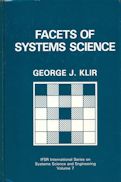
George J. Klir, ed.
Facets of Systems Science.
Plenum. 1991

Contents

• Robert Rosen. Some systems theoretical problems in biology. 1972
• Kenneth E. Boulding. Economics and General Systems. 1972
• Robert Rosen. Some Comments on Systems and System Theory. 1986
• The Emergence of Two Dimensional Science in the Information Society. 1985
• Ernst von Glasersfeld. An Exposition of Constructivism: Why Some Like It Radical. 1990
• Kenneth E. Boulding. General Systems Theory---The Skeleton of Science. 1956
• W. Ross Ashby. General Systems Theory as a New Discipline. 1958
• Peter B. Checkland. Science and the Systems Paradigm. 1976
• Robert Rosen. Old Trends and New Trends in General Systems Research. 1979
• Gregory Bateson. Cybernetic Explanation. 1967
• Joseph A. Goguen, Francisco J. Varela. Systems and Distinctions; Duality and Complementarity. 1979
• Robert Rosen. The Challenges of System Theory. 1981
• L. A. Zadeh. From Circuit Theory to System Theory. 1962
• Russell L. Ackoff. Science in the Systems Age: Beyond IE, OR, and MS. 1973
• Systems Profile: The Emergence of Systems Science. 1988
• Brian R. Gaines. Methodology in the Large: Modeling All There Is. 1984
• Andrew G. Barto. Discrete and Continuous Models. 1978
• Reconstructability Analysis: An Offspring of Asbby's Constraint Analysis. 1986
• W. Ross Ashby. Requisite Variety and Its Implications for the Control of Complex Systems. 1958
• Roger C. Conant. Laws of Information Which Govern Systems. 1976
• Warren Weaver. Science and Complexity. 1948
• Herbert A. Simon. The Architecture of Complexity. 1962
• Robert Rosen. Complexity and System Descriptions. 1977
• Ilya Prigogine. New Perspectives on Complexity. 1985
• Robert Rosen. The Physics of Complexity. 1985
• Gerald M. Weinberg. The Simplification of Science and the Science of Simplification. 1972
• W. Ross Ashby. Introductory Remarks at Panel Discussion. 1964
• Roger C. Conant, W. Ross Ashby. Every Good Regulator of a System Must Be a Model of That System. 1970
• W. Ross Ashby. Principles of the Self-Organizing System. 1962
• Robert Rosen. Anticipatory Systems in Retrospect and Prospect. 1979
• Francisco J. Varela, Humberto R. Maturana, R. Uribe. Autopoiesis: The Organization of Living Systems, Its Characterization and a Model. 1974
• W. Ross Ashby. The Self-Reproducing System. 1962
• Howard H. Pattee. Universal Principles of Measurement and Language Functions in Evolving Systems. 1986
• Mario Bunge. The GST Challenge to the Classical Philosophies of Science. 1977
• James Grier Miller. Can Systems Theory Generate Testable Hypotheses? From Talcott Parsons to Living Systems Theory. 1986