Books

Short works

Books : reviews

Harvey S. Leff, Andrew F. Rex, eds.
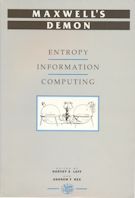
Maxwell's Demon: entropy, information, computing.
Adam Hilger. 1990

About 120 years ago, James Clerk Maxwell introduced his now legendary hypothetical ‘demon’ as a challenge to the integrity of the second law of thermodynamics. Fascination with the demon persisted throughout the development of statistical and quantum physics, information theory and computer science – and links have been established between Maxwell’s demon and each of these disciplines. The demon’s seductive quality makes it appealing to physical scientists, engineers, computer scientists, biologists, psychologists, and historians and philosophers of science.

This book, Maxwell’s Demon: Entropy, Information, Computing, brings under one cover twenty-five reprints, including seminal works by James Clerk Maxwell and William Thomson; historical reviews by Martin Klein, Edward Daub and Peter Heimann; important contributions by Leo Szilard, Leon Brillouin, Dennis Gabor and Jerome Rothstein; and remarkable innovations by Rolf Landauer and Charles Bennett. Until now this important material has been scattered throughout diverse journals.

Maxwell’s Demon: Entropy, Information, Computing makes the key literature easily available and helps with the cross-fertilisation of ideas in different disciplines. An annotated chronological bibliography provides a colourful perspective on Maxwell’s demon and a rich trail of citations for further study.

Contents

• William Thomson. Kinetic theory of the dissipation of energy. Nature, IX. 1874
• Edward E. Daub. Maxwell's demon. Stud. Hist. Phil. Sci., 1. 1970
• Martin J. Klein. Maxwell, his demon, and the second law of thermodynamics. Am. Sci., 58. 1970
• L. Brillouin. Life, thermodynamics, and cybernetics. Am. Sci., 37. 1949
• Jerome Rothstein. Information, measurement, and quantum mechanics. Science, 114. 1951
• Leo Szilard. On the decrease of entropy in a thermodynamic system by the intervention of intelligent beings. Behavioural Science, 9. 1964
• L. Brillouin. Maxwell's demon cannot operate: information and Entropy I. J. Appl. Phys., 22. 1951
• J. M. Jauch, J. G. Baron. Entropy, information and Szilard's paradox. Helv. Phys. Acta., 45. 1972
• Olivier Costa de Beauregard, Myron Tribus. Information theory and thermodynamics. Helv. Phys. Acta., 47. 1974
• Rolf Landauer. Irreversibility and heat generation in the computing process. IBM J. Res. Dev., 5. 1961
• Wojciech H. Zurek. Maxwell's demon, Szilard's engine and quantum measurements. Frontiers of Non-Equilibrium Statistical Physics. 1984
• Elihu Lubkin. Keeping the entropy of measurement: Szilard revisited. Int. J. Theor. Phys., 26. 1987
• Charles H. Bennett. The thermodynamics of computation---a review. Int. J. Theor. Phys., 21. 1982
• Rolf Landauer. Computation: a fundamental physical view. Phys. Scr., 35. 1987
• Charles H. Bennett. Notes on the history of reversible computation. IBM J. Res. Dev., 32. 1988
• P. M. Heimann. Molecular forces, statistical representation and Maxwell's demon. Stud. Hist. Phil. Sci. 1, 213-27. 1970
• Kenneth Denbigh. How subjective is entropy?. Chem. Brit. 17, 168-85. 1981
• Alvin M. Weinberg. On the relation between information and energy systems: a family of Maxwell's demons. Interdisciplinary Sci. Rev. 7, 47-52. 1982
• Richard C. Raymond. The well-informed heat engine. Am. J. Phys. 19, 109-12. 1951
• C. Finfgeld, S. Machlup. Well-informed heat engine: efficiency and maximum power. Am. J. Phys. 28, 324-6. 1960
• Philip Rodd. Some comments on entropy and information. Am. J. Phys. 32, 333-5. 1964
• Dennis Gabor. Light and information. (section 5, appendix IV) Progress in Optics 1, 111-53. 1964
• Andrew F. Rex. The operation of Maxwell's demon in a low entropy system. Am. J. Phys. 55, 359-62. 1987
• Charles H. Bennett. Logical reversibility of computation. IBM J. Res. Dev. 17, 525-32. 1973
• Richard A. Laing. Maxwell's demon and computation. Phil. Sci. 41, 171-8. 1974

Harvey S. Leff, Andrew F. Rex, eds.
Maxwell's Demon 2: entropy, classical and quantum information, computing: 2nd edn.
Institute of Physics. 2003

p.xii. In order to add 16 new reprints, we have reluctantly omitted 10 of the 25 first edtion reprints.

Contents

• Wojciech H. Zurek. Algorithmic Randomness, Physical Entropy, Measurements, and the Demon of Choice. 1998
• Overview to Maxwell's Demon. 2003
• William Thomson. Kinetic theory of the dissipation of energy. Nature, IX. 1874
• Edward E. Daub. Maxwell's demon. Stud. Hist. Phil. Sci., 1. 1970
• Martin J. Klein. Maxwell, his demon, and the second law of thermodynamics. Am. Sci., 58. 1970
• L. Brillouin. Life, thermodynamics, and cybernetics. Am. Sci., 37. 1949
• Jerome Rothstein. Information, measurement, and quantum mechanics. Science, 114. 1951
• P. A. Skordos, Wojciech H. Zurek. Maxwell's demon, rectifiers, and the second law: computer simulation of Smoluchowski's trapdoor. Am. J. Phys., 60. 1992
• Andrew F. Rex, Ross Larson. Entropy and information for an automated Maxwell's demon. PhysComp '92.. 1992
• Leo Szilard. On the decrease of entropy in a thermodynamic system by the intervention of intelligent beings. Behavioural Science, 9. 1964
• L. Brillouin. Maxwell's demon cannot operate: information and Entropy I. J. Appl. Phys., 22. 1951
• J. M. Jauch, J. G. Baron. Entropy, information and Szilard's paradox. Helv. Phys. Acta., 45. 1972
• Olivier Costa de Beauregard, Myron Tribus. Information theory and thermodynamics. Helv. Phys. Acta., 47. 1974
• Rolf Landauer. Irreversibility and heat generation in the computing process. IBM J. Res. Dev., 5. 1961
• Entropy of measurement and erasure: Szilard's membrane model revisited. Am. J. Phys., 63. 1994
• Kousuke Shizume. Heat generation required by erasure. Phys. Rev. E, 52. 1995
• Barbara Piechocinska. Information erasure. Phys. Rev. A, 61. 2000
• Wojciech H. Zurek. Maxwell's demon, Szilard's engine and quantum measurements. Frontiers of Non-Equilibrium Statistical Physics. 1984
• Elihu Lubkin. Keeping the entropy of measurement: Szilard revisited. Int. J. Theor. Phys., 26. 1987
• Seth Lloyd. Use of mutual inforation to decrease entropy: implications for the second law of thermodynamics. Phys. Rev. A, 39. 1989
• Seth Lloyd. Quantum-mechanical Maxwell's demon. Phys. Rev. A, 56. 1997
• Vlatko Vedral. Landauer's erasure, error correction and entanglement. Proc. R. Soc. Lond. A, 456. 2000
• Carlton M. Caves. Information and entropy. Phys. Rev. E, 47. 1993
• Rudiger Schack. Algorithmic information and simplicity in statistical physics. Int. J. Theor. Phys., 21. 1997
• Charles H. Bennett. The thermodynamics of computation---a review. Int. J. Theor. Phys., 21. 1982
• Rolf Landauer. Computation: a fundamental physical view. Phys. Scr., 35. 1987
• Charles H. Bennett. Notes on the history of reversible computation. IBM J. Res. Dev., 32. 1988
• Rolf Landauer. The physical nature of information. Phys. Rev. A, 217. 1996
• Rolf Landauer. Minimal energy requirements in communication. Science, 272. 1996
• Charles H. Bennett. Information physics in cartoons. Superlattices and Microstructures, 23. 1998
• Neil A. Gershenfeld. Signal entropy and the thermodynamics of computation. IBM Sys. J., 35. 1996
• Seth Lloyd. Ultimate physical limits to computation. Nature, 406. 2000