Books

Short works

Books : reviews

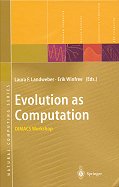
Laura F. Landweber, Erik Winfree, eds.
Evolution as Computation: DIMACS workshop, Princeton, 1999.
Springer. 2002

Contents

• James A. Shapiro. Genome System Architecture and Natural Genetic Engineering. 2002
• Thomas Back, Joost N. Kok, Grzegorz Rozenberg. Evolutionary Computation as a Paradigm for DNA-Based Computing. 2002
• Patricia K. Theodosopoulos, Theodore V. Theodosopoulos. Evolution at the Edge of Chaos: A Paradigm for the Maturation of the Humoral Immune Response. 2002
• James P. Crutchfield, Erik van Nimwegen. The Evolutionary Unfolding of Complexity. 2002
• John R. Koza, Forrest H. Bennett III, David Andre, Martin A. Keane. Genetic Programming: Biologically Inspired Computation That Creatively Solves Non-trivial Problems. 2002
• Stephen J. Freeland. Is Ours the Best of All Possible Codes?. 2002
• Guy Sella, David H. Ardell. The Impact of Message Mutation on the Fitness of a Genetic Code. 2002
• Robin D. Knight. Genetic Code Evolution in the RNA World and Beyond. 2002
• Mark Ptashne, Alexander Gann. Imposing Specificity by Localization: Mechanism and Evolvability. 2002
• Drew Endy. Towards a Predictive Biology: The Example of Bacteriophage T7. 2002
• Roger Brent. Using Artificial Reagents to Dissect Cellular Genetic Networks. 2002
• Andrzej Ehrenfeucht, David M. Prescott, Grzegorz Rozenberg. Computational Aspects of Gene (Un)Scrambling in Ciliates. 2002
• Laura F. Landweber, Lila Kari. Universal Molecular Computation in Ciliates. 2002
• Ron Weiss, George E. Homsy, Thomas F. Knight Jr. Toward in vivo Digital Circuits. 2002
• Charles Ofria, Christoph Adami. Evolution of Genetic Organization in Digital Organisms. 2002
• Eric B. Baum, Igor Durdanovic. Toward Code Evolution by Artificial Economies. 2002

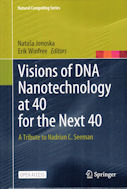
Natasha Jonoska, Erik Winfree.
Visions of DNA Nanotechnology at 40 for the Next 40: a tribute to Nadrian C. Seeman.
Springer. 2023

+

This open access book provides a unique and state-of-the-art view on DNA nanotechnology with an eye toward future developments. Intended as a tribute to Nadrian C. Seeman, who founded the field of DNA nanotechnology, the content is an exciting mixture of technical and non-technical material, reviews, tutorials, perspectives, new findings, and open questions. The book aims to inspire current researchers to sit back and think about the big picture, while also enticing new researchers to enter the field. Most of all, the book captures voices from a unique moment in time: 40 years after the publication of the first paper that envisioned DNA nanotechnology.

From this vantage point, what are the untold stories, the unspoken concerns, the underlying fundamental issues, the overlooked opportunities, and the unifying grand challenges? What will help us see more clearly, see more creatively, or see farther? What is transpiring right now that could pave the way for the future? To address these questions, leading researchers have contributed 22 chapters, grouped into five sections: perspectives, chemistry and physics, structures, biochemical circuits, and spatial systems.

This book will be an important reference point in the field of DNA nanotechnology, both for established researchers looking to take stock of the field and its future, and for newcomers such as graduate students and researchers in other fields who are beginning to appreciate the power and applicability of its methods.