Books

Short works

Books : reviews

Grzegorz Rozenberg, Arto Salomaa, eds.
L Systems.
Springer. 1974

Contents

• Grzegorz Rozenberg. Theory of L systems: From the point of view of formal language theory . 1974
• D. Frijters, Aristid Lindenmayer. A model for the growth and flowering of aster novae-angliae on the basis of table <1,0> L-systems. 1974
• Aristid Lindenmayer. Adding continuous components to L-systems. 1974
• Vahe Bedian, Gabor T. Herman. Formal language theoretical approach to intracellular behavior. 1974
• Andrzej Ehrenfeucht, Grzegorz Rozenberg. Three useful results concerning L languages without interactions. 1974
• Paul M. B. Vitányi. Growth of strings in context dependent Lindenmayer systems. 1974
• Juhani Karhumaki. Some growth functions of context-dependent L-systems. 1974
• Andrzej Ehrenfeucht, Grzegorz Rozenberg. D0L systems with rank. 1974
• Mogens Nielsen. Equivalence of L-systems. 1974
• P. G. Doucet. The syntactic inference problem for D0L-sequences. 1974
• Peter Johansen, Erik Meiling. Free groups in Lindenmayer systems. 1974
• Jan van Leeuwen. Notes on pre-set pushdown automata. 1974
• Gabor T. Herman. Recurrence systems. 1974
• Adrian D. Walker. Adult languages of L systems and the Chomsky hierarchy. 1974
• Karel Culik II. Structured 0L-Systems. 1974
• Karel Culik II, Jaroslav Opatrny. Context in parallel rewriting. 1974
• Sven Skyum. Nonterminals and codings in defining variations of 0L-systems. 1974
• Arto Salomaa. Iteration grammars and Lindenmayer AFL's. 1974
• P. A. Christensen. Hyper-AFL's and ETOL systems. 1974
• Andrew L. Szilard. Omega-0L systems. 1974
• Derick Wood. Bounded parallelism and regular languages. 1974
• Brian H. Mayoh. Multidimensional Lindenmayer organisms. 1974

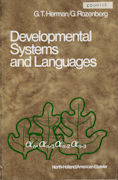
Gabor T. Herman, Grzegorz Rozenberg.
Developmental Systems and Languages.
North-Holland. 1975

The theory of developmental systems and languages is the result of an infusion of ideas from developmental biology into formal language theory. It has become a very actively investigated topic in the last few years, and produced many results of interest both for the formal language theorist and for the biologist. The purpose of our book is to provide a self-contained text on this new important scientific area, which nevertheless provides an exhaustive survey of the state-of-the-art at the time of writing.

The book consists of an introduction followed by three main sections. The biological motivation behind our study is to be found in the introductory section. Parts I and II form the main body of the work. They provide a rather formal presentation of the theory of developmental languages and developmental sequences respectively. Only concise references are given to biological motivation inside these parts, and some of the topics are investigated more for their intrinsic formal language theoretical interest than for their relevance to biology. In Part III we return to a less formal discussion of topics whose biological motivation is more apparent. Having read the book, the reader should refer back to the introduction to see how the formal theory meshes with the underlying biological questions.
Grzegorz Rozenberg, Arto Salomaa.
Cornerstones of Undecidability.
Prentice Hall. 1994

Andrzej Ehrenfeucht, Tero Harju, Ion Petre, David M. Prescott, Grzegorz Rozenberg.
Computation in Living Cells: gene assembly in ciliates.
Springer. 2004

Gabriel Ciobanu, Grzegorz Rozenberg, eds.
Modelling in Molecular Biology.
Springer. 2004

This volume consists of papers concerned with models and methods used in solving some fundamental problems of biosciences. They represent a wide spectrum of diverse ideas and trends. In particular, they reflect the genuinely interdisciplinary nature of research on modelling in molecular biology – the inspiration, ideas and techniques presented in this volume come from mathematics, computer science, statistics, chemistry and biology.

Contents

• Daniel A. Beard, Hong Qian, James B. Bassingthwaighte. Stoichiometric foundation of large-scale biochemical system analysis. 2004
• Paulo R. A. Campos, Christoph Adami, Claus O. Wilke. Modelling stochastic clonal interference. 2004
• Gabriel Ciobanu. Software verification of biomolecular systems. 2004
• Oleg V. Demin, Galina V. Lebedeva, Alex G. Kolupaev, E. A. Zobova, T. Yu. Plyusnina, A. I. Lavrova, A. Dubinsky, E. A. Goryacheva, Frank Tobin, Igor I. Goryanin. Kinetic modelling as a modern technology to explore and modify living cells. 2004
• Andrzej Ehrenfeucht, Tero Harju, Ion Petre, David M. Prescott, Grzegorz Rozenberg. Modelling gene assembly in ciliates. 2004
• Masami Hagiya. Towards molecular programming -- a personal report on DNA8 and Molecular Computing. 2004
• Sungchul Ji. Molecular information theory: solving the mysteries of DNA. 2004
• Na'aman Kam, David Harel, Hillel Kugler, Rami Marelly, Amir Pnueli, E. Jane Albert Hubbard, Michael J. Stern. Formal modelling of C. elegans. development: a scenario-based approach. 2004
• Carlos Martin-Vide, Gheorghe Paun. P Systems with symport/antiport rules: a survey. 2004
• Santo Motta, Vladimir Brusic. Mathematical modelling of the immune system. 2004
• Aviv Regev, Ehud Shapiro. The pi-calculus as an abstraction for biomolecular systems. 2004
• Barbel M. R. Stadler, Peter F. Stadler. The topology of evolutionary biology. 2004
• Yi Zhou, Bud Mishra. Models of genome evolution. 2004

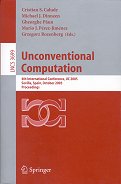
Cristian S. Calude, Michael J. Dinneen, Gheorghe Paun, Mario J. Perez-Jimenez, Grzegorz Rozenberg, eds.
Unconventional Computation, UC 2005: Seville, Spain.
Springer. 2005

+

(read but not reviewed)

Contents

• Thomas Back, Ron Breukelaar. Using Genetic Algorithms to Evolve Behavior in Cellular Automata. 2005
• Lov K. Grover. Quantum Searching Amidst Uncertainty. 2005
• Eric H. Davidson, Sorin Istrail. Logic Functions of the Genomic Cis-regulatory Code (abstract). 2005
• Ruojie Sha, Xiaoping Zhang, Shiping Liao, Pamela E. Constantinou, Baoquan Ding, Tong Wang, Alejandra V. Garibotti, Hong Zhong, Lisa B. Israel, Xing Wang, Gang Wu, Banani Chakraborty, Junghuei Chen, Yuwen Zhang, Hao Yam, Zhiyong Shen, Wanqiu Shen, Phiset Sa-Ardyen. Structural DNA Nanotechnology: Molecular Construction and Computation. 2005
• Carme Torras. Natural Inspiration for Artificial Adaptivity: Some Neurocomputing Experiences in Robotics. 2005
• Francesco Bernardini, Marian Gheorghe, Natalio Krasnogor, Jean-Louis Giavitto. On Self-assembly in Population P Systems. 2005
• Cosmin Bonchis, Gabriel Ciobanu, Cornel Izbasa, Dana Petcu. A Web-Based P Systems Simulator and Its Parallelization. 2005
• Adan Cabello. Communication Complexity as a Principle of Quantum Mechanics. 2005
• Zhe Dang, Oscar H. Marra, Cheng Li, Gaoyan Xie. On Model-Checking of P Systems. 2005
• Carmen Graciani-Diaz, Agustin Riscos-Nunez. Looking for Simple Common Schemes to Design Recognizer P Systems with Active Membranes That Solve Numerical Decision Problems. 2005
• Miguel A. Gutierrez-Naranjo, Mario J. Perez-Jimenez, Agustin Riscos-Nunez, Francisco J. Romero-Campero. P Systems with Active Membranes, Without Polarizations and Without Dissolution: A Characterization of P. 2005
• Masami Hagiya. Discrete State Transition Systems on Continuous Space-Time: A Theoretical Model for Amorphous Computing. 2005
• Shuichi Inokuchi, Kazumasa Honda, Hyen Yeal Lee, Tatsuro Sato, Yoshihiro Mizoguchi, Yasuo Kawahara. On Reversible Cellular Automata with Finite Cell Array. 2005
• Natasha Jonoska, Gregory L. McColm. A Computational Model for Self-assembling Flexible Tiles. 2005
• Kojiro Kobayashi, Darin Goldstein. On Formulations of Firing Squad Synchronization Problems. 2005
• Oleksiy Kurganskyy, Igor Potapov. Computation in One-Dimensional Piecewise Maps and Planar Pseudo-Billiard Systems. 2005
• Marius Nagy, Selim G. Akl. On the Importance of Parallelism for Quantum Computation and the Concept of a Universal Computer. 2005
• Predrag T. Tosic, Gul A. Agha. On Computational Complexity of Counting Fixed Points in Symmetric Boolean Graph Automata. 2005
• Tereza Tusarova. A New Sibling of BQP. 2005
• Hiroshi Umeo, Masaya Hisaoka, Shunsuke Akiguchi. A Twelve-State Optimum-Time Synchronization Algorithm for Two-Dimensional Rectangular Cellular Arrays. 2005
• Jiri Wiedermann. Computing by Self-reproduction: Autopoietic Automata. 2005
• Damien Woods, J. Paul Gibson. Lower Bounds on the Computational Power of an Optical Model of Computation. 2005
• Paolo Zuliani. On Counterfactual Computation. 2005

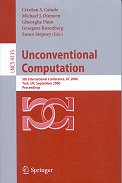
Cristian S. Calude, Michael J. Dinneen, Gheorghe Paun, Grzegorz Rozenberg, Susan Stepney, eds.
Unconventional Computation, UC 2006: York, UK.
Springer. 2006

+

(read but not reviewed)

Contents

• Aurelie Goulon, Arthur Duprat, Gerard Dreyfus. Graph Machines and their applications to computer-aided drug design: a new approach to learning from structured data. 2006
• Michael C. Mozer. Rational models of cognitive control. 2006
• Erik Winfree. Fault-tolerance in biochemical systems (abstract). 2006
• Damien Woods. Optical computing and computational complexity. 2006
• Russ Abbott. If a tree casts a shadow is it telling the time?. 2006
• M. Sakthi Balan, Helmut Jurgensen. Peptide computing -- universality and theoretical model. 2006
• Monica Cardona, M. Angels Colomer, Mario J. Perez-Jimenez, Alba Zaragoza. Handling Markov Chains with Membrane Computing. 2006
• Uffe Flarup, Klaus Meer. Approximation classes for real number optimization problems. 2006
• Peter Hines. Physical systems as constructive logics. 2006
• Oscar H. Ibarra, Sara Woodworth, Fang Yu, Andrei Paun. On spiking neural P Systems and partially blind counter machines. 2006
• Yasuhiro Igarashi, Jerzy Gorecki, Joanna Natalia Gorecka. Chemical information processing devices constructed using a nonlinear medium with controlled excitability. 2006
• Natasha Jonoska, Gregory L. McColm. Flexible versus rigid tile assembly. 2006
• Shankara Narayanan Krishna. On pure catalytic P Systems. 2006
• William B. Langdon. Mapping non-conventional extensions of Genetic Programming. 2006
• Akihiro Mikoda, Shuichi Inokuchi, Yoshihiro Mizoguchi, Mitsuhiko Fujio. The number of ordits of periodic box-ball systems. 2006
• Jerzy Mycka, Francisco Coelho, Jose Felix Costa. The Euclid Abstract Machine: trisection of the angle and the Halting Problem. 2006
• Shigeru Ninagawa. 1/f noise in elementary cellular automaton rule 110. 2006
• Mihai Oltean. A light-based device for solving the Hamiltonian path problem. 2006
• Mikhail Prokopenko, Daniel Polani, Peter Wang. Optimizing potential information transfer with self-referential memory. 2006
• H. Ramesh, Shankara Narayanan Krishna, Raghavan Rama. On the power of bio-Turing machines. 2006
• Dylan A. Shell, Maja J. Mataric. Ergodic dynamics for large-scale distributed robot systems. 2006

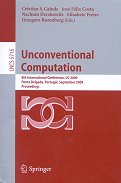
Cristian S. Calude, Jose Felix Costa, Nachum Dershowitz, Elisabete Freire, Grzegorz Rozenberg.
Unconventional Computation, UC 2009: Ponta Delgada, Azores, Portugal.
Springer. 2009

+

(read but not reviewed)

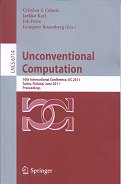
Cristian S. Calude, Jarkko Kari, Ion Petre, Grzegorz Rozenberg, eds.
Unconventional Computation, UC 2011: Turku, Finland.
Springer. 2011

+

(read but not reviewed)

Contents

• Viv Kendon, Angelika Sebald, Susan Stepney, Matthias Bechmann, Peter Hines, Robert C. Wagner. Heterotic Computing. 2011

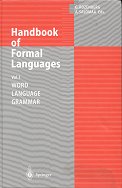
Grzegorz Rozenberg, Arto Salomaa, eds.
Word, Language, Grammar.
Springer. 1997

Contents

• Alexandru Mateescu, Arto Salomaa. Formal Languages: an Introduction and a Synopsis. 1997
• Sheng Yu. Regular Languages. 1997
• Jean-Michel Autebert, Jean Berstel, Luc Boasson. Context-Free Languages and Pushdown Automata. 1997
• Alexandru Mateescu, Arto Salomaa. Aspects of Classical Language Theory. 1997
• Lila Kari, Grzegorz Rozenberg, Arto Salomaa. L Systems. 1997
• Christian Choffrut, Juhani Karhumaki. Combinatorics of Words. 1997
• Tero Harju, Juhani Karhumaki. Morphisms. 1997
• Helmut Jurgensen, Stavros Konstantinidis. Codes. 1997
• Werner Kuich. Semirings and Formal Power Series. 1997
• Jean-Eric Pin. Syntactic Semigroups. 1997
• Aldo de Luca, Stefano Varricchio. Regularity and Finiteness Conditions. 1997
• Gheorghe Paun, Arto Salomaa. Families Generated by Grammars and L Systems. 1997

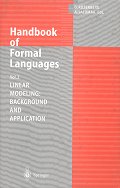
Grzegorz Rozenberg, Arto Salomaa, eds.
Linear Modeling: background and application.
Springer. 1997

Contents

• Cristian S. Calude, Juraj Hromkovic. Complexity: A Language-Theoretic Point of View. 1997
• Klaas Sikkel, Anton Nijholt. Parsing of Context-Free Languages. 1997
• Jurgen Dassow, Gheorghe Paun, Arto Salomaa. Grammars with Controlled Derivations. 1997
• Jurgen Dassow, Gheorghe Paun, Grzegorz Rozenberg. Grammar Systems. 1997
• Solomon Marcus. Contextual Grammars and Natural Languages. 1997
• Andrzej Ehrenfeucht, Gheorghe Paun, Grzegorz Rozenberg. Contextual Grammars and Formal Languages. 1997
• Thomas Head, Gheorghe Paun, Dennis Piton. Language Theory and Molecular Genetics. 1997
• Alberto Apostolico. String Editing and Longest Common Subsequences. 1997
• Maxime Crochemore, Christophe Hancart. Automata for Matching Patterns. 1997
• Marie-Pierre Beal, Dominique Perrin. Symbolic Dynamics and Finite Automata. 1997
• Valtteri Niemi. Cryptology: Language-Theoretic Aspects. 1997

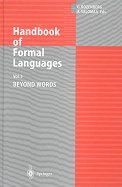
Grzegorz Rozenberg, Arto Salomaa, eds.
Beyond Words.
Springer. 1997

Contents

• Ferenc Gecseg, Magnus Steinby. Tree Languages. 1997
• Aravind K. Joshi, Yves Schabes. Tree-Adjoining Grammars. 1997
• Joost Engelfriet. Context-Free Graph Grammars. 1997
• Dora Giammarresi, Antonio Restivo. Two-Dimensional Languages. 1997
• Matthias Jantzen. Basics of Term Rewriting. 1997
• Ludwig Staiger. omega-Languages. 1997
• Wolfgang Thomas. Languages, Automata, and Logic. 1997
• Volker Diekert, Yves Metivier. Partial Commutation and Traces. 1997
• Przemyslaw Prusinkiewicz, Mark Hammel, Jim Hanan, Radomir Mech. Visual Models of Plant Development. 1997
• Karel Culik II, Jarkko Kari. Digital Images and Formal Languages. 1997

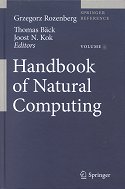
Grzegorz Rozenberg, Thomas Back, Joost N. Kok.
Handbook of Natural Computing, vol 1.
Springer. 2012

+

Grzegorz Rozenberg, Thomas Back, Joost N. Kok.
Handbook of Natural Computing, vol 2.
Springer. 2012

Grzegorz Rozenberg, Thomas Back, Joost N. Kok.
Handbook of Natural Computing, vol 3.
Springer. 2012

Grzegorz Rozenberg, Thomas Back, Joost N. Kok.
Handbook of Natural Computing, vol 4.
Springer. 2012