
 >
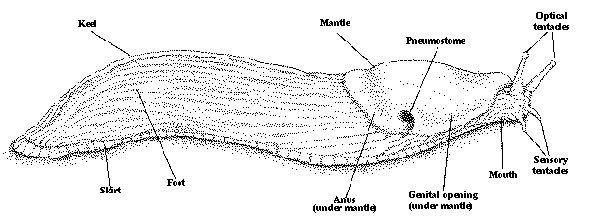
>  Although a large number of different species of slug are found in agricultural
crops, the majority of the damage is caused by the field slug Deroceras
reticulatum (left), and to a lesser extent Arion spp. and milacid
slugs.
Although a large number of different species of slug are found in agricultural
crops, the majority of the damage is caused by the field slug Deroceras
reticulatum (left), and to a lesser extent Arion spp. and milacid
slugs.
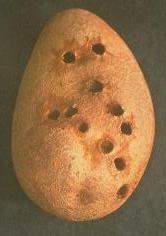
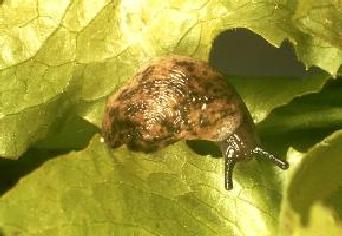
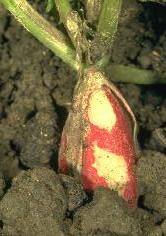
The pictures below show the damage done by slugs to potatoes (left) and radishes (right), and D. reticulatum attacking lettuce (middle).
Slugs have a large number of predators, including parasitic nematodes. The most popular method for dealing with them is chemical pellets, either metaldehyde or, more common in agriculture methiocarb (3,5-dimethyl-4- (methylthio) phenyl methylcarbamate C11H15NO2S) based. These have a number of problems, and are clearly not suitable for organic farming. Even in conventional farming, most European countries have a minimum time after application before crops are allowed to be harvested. In addition to slugs and snails, pellets kill many natural predators of slugs such as birds, beetles, hedgehogs, as well as pets(cats, dogs, tortoises etc). This may be either by directly eating pellets (dogs can become addicted to the pellets), or through consuming poisoned slugs. In fact, some researchers have considered methiocarb to control problem bird populations, and the Ministry of Agiiculture once advised the use of slug pellets for the control of small mammals on farms. Chemical treatments are also often highly susceptible to rain, and get washed away. This not only makes them ineffectual against slugs, but results in the pollution of rivers and other areas.
There are however numerous of other ways of dealing with them, including encouraging natural predators such as frogs, birds, hedgehogs and beetles. In a gardening context, there are many things you can do - lots of useful information is given on Dr Bill Symondson's Slug Control page. Pro-active controls (apart from the nematodes considered here) which do not harm the environment include beer traps, barrier tape and barrier paste.
There are numerous Slug Sites - both for and
against them! Below are a selection of the most informative or bio-control
biased ones, or particularly good jump stations. Please feel free to contact us if there are any sites
you think should be added.
Australian Museum online malacology section: "Great websites for Mollusc information". Lots of links to many informative sites.
Internet Resource Guide for Zoology from BIOSIS and the Zoological Society of London. Links to scientific and technical sites, including more general mollusca.
Institut National de la Recherche Agronomique. A comprehensive website on the zoology of slugs, including detailed information on individual species.
Dr Bill Symondson's Slug Control page, offering invaluable advice on ways to deal with slugs in your garden.
The Crop Ecology and Management Group, Long Ashton Research Station (part of The Institute of Arable Crop Research). Lots of interesting research on, among other things, slug control. The groups is concerned with less intensive integrated crop management, modelling effects of climate change on crops, population dynamics and biological and integrated control of slugs.
Novel technologies for integrated control of slug damage in key horticultural crops. A European Union funded research project at Long Ashton Research Station (part of The Institute of Arable Crop Research).
Golden Harvest Organics. Slug and slug control information including organic crop protection products.
Slug Web - not a huge amount of information but much devotion to the mascot of the University of California at Santa Cruz - perhaps even enough to make us all appreciate slugs a little more!