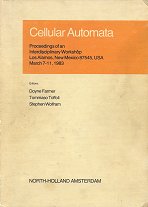
J. Doyne Farmer, Tommaso Toffoli, Stephen Wolfram, eds.
Cellular Automata: Proceedings of an Interdisciplinary Workshop, Los Alamos March 7-11, 1983 (Physica D 10).
North Holland. 1984
(read but not reviewed)
Contents
- • Norman H. Margolus. Physics-like models of computation. Physica 10D. 1984
- • Stephen Wolfram. Universality and complexity in Cellular Automata. 1984
- • Douglas A. Lind. Applications of ergodic theory and sofic systems to Cellular Automata. 1984
- • Michael S. Waterman. Some applications of information theory to Cellular Automata. 1984
- • Peter Grassberger. Chaos and diffusion in deterministic Cellular Automata. 1984
- Encode the 1D CA state …s-2s-1s0s1s2… as the 2D point (0.s0s1s2…, 0.s-1s-2…) • "similar" states are "close" in space (with a bias to similarity near cell c0, consistent with the Cantor set topology explained in [Toffoli 1984a] below) • time evolution is a trajectory in this space • some CA rules have dynamics that exhibit an "attractor"-like structure (although not completely identical) in this space
- • T. E. Ingerson, R. L. Buvel. Structure in asynchronous Cellular Automata. 1984
- asynchronous 1D CA investigations • random, and own clock • these models are more "natural" • some self-organisin behaviour of synchronous 1D CAs comes from the synchronisation • some further interesting behaviour appears with asynchronous models
- • Stephen J. Willson. Growth rates and fractional dimensions in Cellular Automata. 1984
- • R. Wm. Gosper. Exploiting regularities in large cellular spaces. 1984
- Optimisation algorithm for 2D CAs, using quadrant decomposition of cellular space, cacheing of results, and hashing to find previously used quadrants
- • Gerard Y. Vichniac. Simulating physics with Cellular Automata. 1984
- CAs exactly computable models, and non-numerical simulations • a naive CA implementation of a spin glass gives poor results
- • Tommaso Toffoli. Cellular Automata as an alternative to (rather than an approximation of) differential equations in modeling physics. 1984
- why CAs are appropraite for direct modelling of physical systems • Cantor set topology of infinite CAs
- • Stephen M. Omohundro. Modelling Cellular Automata with partial differential equations. 1984
- • Christopher G. Langton. Self-reproduction in Cellular Automata. 1984
- requirement that self-replicator be a universal constructor is too strong: natural self-replicators (organisms!) aren't universal constructors • relax therequirement simply to: the "self-replicating" configuration must treat its stored information both as interpreted instructions and uninterpreted data • adaptation of Codd's 1968 universal constructor, with a different transition rule • states comprise instructions for constructing a new loop • instructions travel around the loop, memory - uninterpreted • instructions construct new loop - interpreted
- • Stuart A. Kauffman. Emergent properties in random complex automata. 1984
- N cells with boolean state, each getting input from K other randomly chosen cells, combined by a randomly chosen boolean function • K = 2 dynamics properties : number of states = 2N, yet cycle length, number of distinct cycles (basins of attraction) ~ N1/2; cycles relatively stable to small perturbations • canalising rules, and forcing structures - subgraphs that "crystallise" at their canalised values - and so partition the remaining graph into isolated subclusters • as simple models of geneetic regulatory networks
- • Christian Burks, J. Doyne Farmer. Towards modeling DNA sequences as automata. 1984
- • Steven A. Smith, Richard C. Watt, Stuart R. Hameroff. Cellular Automata in cytoskeletal lattices. 1984
- • Forrest L. Carter. The molecular device computer: point of departure for large scale Cellular Automata. 1984
- • Tommaso Toffoli. CAM: a high-performance Cellular-Automaton Machine. 1984
- support for "watching 2D CA evolution • sequential processing, special-purpose hardware • 256x256 array of cells, periodic (toroidal) boundary conditions • each cell with up to 256 states • 60 timesteps per second display
- • Kendall Preston Jr. Four-dimensional logical transforms: data processing by Cellular Automata. 1984
- • W. Daniel Hillis. The Connection Machine: a computer architecture based on Cellular Automata. 1984
- • James P. Crutchfield. Space-time dynamics in video feedback. 1984