Books

Short works

Books : reviews

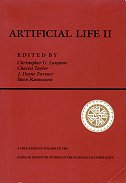
Christopher G. Langton, Charles E. Taylor, J. Doyne Farmer, Steen Rasmussen, eds.
Artificial Life II: proceedings of the workshop on the Synthesis and Simulation of Living Systems, Santa Fe, 1990.
Addison Wesley. 1992

(read but not reviewed)

The papers are gathered under the following headings: • Overview • Origin/Self-Organization • Evolutionary Dynamics • Development • Learning and Evolution • Computation • Philosophy/Emergence • The Future

Contents

• Thomas S. Ray. An Approach to the Synthesis of Life. 1992
A description of his virtual Tierra environment, for studying artificial open-ended evolution
• Christopher G. Langton. Introduction to Artificial Life II. 1992
• Charles E. Taylor. "Fleshing Out" Artificial Life II. 1992
• Christopher G. Langton. Life at the Edge of Chaos. 1992
• Richard J. Bagley, J. Doyne Farmer. Spontaneous Emergence of a Metabolism. 1992
• Richard J. Bagley, J. Doyne Farmer, Walter Fontana. Evolution of a Metabolism. 1992
• Walter Fontana. Algorithmic Chemistry. 1992
• Steen Rasmussen, Carsten Knudsen, Rasmus Feldberg. Dynamics of Programmable Matter. 1992
• Maarten Boerlijst, Paulien Hogeweg. Self-Structuring and Selection: Spiral Waves as a Substrate for Prebiotic Evolution. 1992
• Peter Schuster. Complex Optimization in an Artificial RNA World. 1992
• Kristian Lindgren. Evolutionary Phenomena in Simple Dynamics. 1992
• W. Daniel Hillis. Co-Evolving Parasites Improve Simulated Evolution as an Optimization Procedure. 1990
• Stuart A. Kauffman, Sonke Johnson. Co-Evolution to the Edge of Chaos: Coupled Fitness Landscapes, Poised States, and Co-Evolutionary Avalanches. 1992
• David G. Stork, Bernie Jackson, Scott Walker. "Non-Optimality" via Pre-Adaptation in Simple Neural Systems. 1992
• Mark A. Bedau, Norman H. Packard. Measurement of Evolutionary Activity, Teleology, and Life. 1992
• Martin J. de Boer, F. David Fracchia, Przemyslaw Prusinkiewicz. Analysis and Simulation of the Development of Cellular Layers. 1992
• David H. Ackley, Michael L. Littman. Interactions Between Learning and Evolution. 1992
• Richard K. Belew, John McInerney, Nicol N. Schraudolph. Evolving Networks: Using the Genetic Algorithm with Connectionist Learning. 1992
• David R. Jefferson, Robert J. Collins, Claus Cooper, Michael G. Dyer, Margot Flowers, Richard Korf, Charles E. Taylor, Alan Wang. Evolution as a Theme in Artificial Life: The Genesys/Tracker System. 1992
• Robert J. Collins, David R. Jefferson. AntFarm: Towards Simulated Evolution. 1992
• John R. Koza. Genetic Evolution and Co-Evolution of Computer Programs. 1992
• Bruce J. MacLennan. Synthetic Ethology: An Approach to the Study of Communication. 1992
• Gregory M. Werner, Michael G. Dyer. Evolution of Communication in Artificial Organisms. 1992
• Edwin Hutchins, Brian Hazlehurst. Learning in the Cultural Process. 1992
• Alvy Ray Smith. Simple Nontrivial Self-Reproducing Machines. 1992
• Eugene H. Spafford. Computer Viruses--A Form of Artificial Life?. 1992
• Elliott Sober. Learning from Functionalism--Prospects for Strong Artificial Life. 1992
• Steen Rasmussen. Aspects of Information, Life, Reality, and Physics. 1992
• Peter Cariani. Emergence and Artificial Life. 1992
• Louis Bec. Elements d'Epistemologie Fabulatoire. 1992
[in French]
• J. Doyne Farmer, Alletta d'A. Belin. Artificial Life: The Coming Evolution. 1992
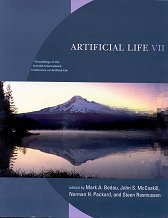
Mark A. Bedau, John S. McCaskill, Norman H. Packard, Steen Rasmussen, eds.
Artificial Life VII: proceedings of the seventh international conference on artificial life, Portland OR.
MIT Press. 2000

(read but not reviewed)

The papers are gathered under the following headings: • Origin of Life, Self-Organization, and Self-Replication • Development and Differentiation • Evolutionary and Adaptive Dynamics • Robots and Autonomous Agents • Communication, Cooperation, and Collective Behavior • Methodological and Technological Applications • The Broader Context

Contents

• Hector Fabio Restrepo, Daniel Mange, Moshe Sipper. A Self-Replicating Universal Turing Machine: From von Neumann's Dream to New Embryonic Circuits. 2000
• Alan Dorin. Creating a Physically-based, Virtual-Metabolism with Solid Cellular Automata. 2000
• Hiroki Sayama. Self-Replicating Worms That Increase Structural Complexity through Gene Transmission. 2000
• Uwe Tangen. Self-Organisation in Micro-Configurable Hardware. 2000
• Hugues Bersini. Reaction Mechanisms in the OO Chemistry. 2000
• Pietro Speroni di Fenizio. A Less Abstract Artificial Chemistry. 2000
• Yasuhiro Suzuki, Hiroshi Tanaka. Chemical Evolution among Artificial Proto-cells. 2000
• Harald Huning. A Search for Multiple Autocatalytic Sets in Artificial Chemistries based on Boolean Networks. 2000
• Ezequiel A. Di Paolo. Searching for Rhythms in Asynchronous Random Boolean Networks. 2000
• S. Kazadi, D. Lee, R. Modi, J. Sy, W. Lue. Levels of Compartmentalization in Alife. 2000
• Keith Downing. Exploring Gaia Theory: Artificial Life on a Planetary Scale. 2000
• Chikara Furusawa, Kunihiko Kaneko. Complex Organization in Multicellularity as a Necessity in Evolution. 2000
• Kunihiko Kaneko, Tetsuya Yomo. Sympatric Speciation from Interaction-induced Phenotype Differentiation. 2000
• Hiroaki Takagi, Kunihiko Kaneko. Evolution of Genetic Code through Isologous Diversification of Cellular States. 2000
• Thomas S. Ray, Joseph F. Hart. Evolution of Differentiation in Multithreaded Digital Organisms. 2000
• Cefn Hoile, Richard Tateson. Design by Morphogenesis. 2000
• Alistair G. Rust, Rod Adams, Hamid Bolouri. Evolutionary Neural Topiary: Growing and Sculpting Artificial Neurons to Order. 2000
• David G. Green, David Newth, Michael G. Kirley. Connectivity and Catastrophe---Towards a General Theory of Evolution. 2000
• Rob Shipman, Mark Shackleton, Marc Ebner, Richard A. Watson. Neutral Search Spaces for Artificial Evolution: A Lesson from Life. 2000
• Richard A. Watson, Torsten Reil, Jordan B. Pollack. Mutualism, Parasitism, and Evolutionary Adaptation. 2000
• Michael L. Best. Coevolving Mutualists Guide Simulated Evolution. 2000
• Eizo Akiyama, Kunihiko Kaneko. Evolution of Cooperation in Social Dilemma---Dynamical Systems Game Approach. 2000
• Takaya Arita, Reiji Suzuki. Interactions between Learning and Evolution: The Outstanding Strategy Generated by the Baldwin Effect. 2000
• Hideaki Suzuki. Evolvability Analysis: Distribution of Hyperblobs in a Variable-Length Protein Genotype Space. 2000
• Daniel Wagenaar, Christoph Adami. Influence of Chance, History and Adaptation on Evolution in Digitalia. 2000
• Stevan Jay Anastasoff. Ecology and Extinction---Macroevolutionary Extinction Dynamics in a Simulated Ecosystem. 2000
• Shinichiro Yoshii, Eiichi Miyamoto, Yukinori Kakazu. Quantification of Microscopic Events in the Process of Long-Term Evolutionary Dynamics. 2000
• Russell K. Standish. An Ecolab Perspective on the Bedau Evolutionary Statistics. 2000
• Patricio Lerena. Mate Choice: Simple or Complex?. 2000
• Paul Domjan. A Discussion of the Use of Artificial Life Models to Evaluate Gould's Hypothesis about Progress in Evolution. 2000
• Tatsuo Unemi. Should Seeds Fly or Not?. 2000
• Bernard D. Reger, Karen M. Fleming, Vittorio Sanguineti, Simon Alford, Ferdinando A. Mussa-Ivaldi. Connecting Brains to Robots: The Development of a Hybrid System for the Study of Learning in Neural Tissues. 2000
• Stevan Jay Anastasoff. A ' Fitness Landscaping' Comparison of Evolved Robot Control Systems. 2000
• Hod Lipson, Jordan B. Pollack. Evolving Physical Creatures. 2000
• Edgar E. Vallejo, Ferdando Ramos. Evolving Insect Locomotion Using Non-uniform Cellular Automata. 2000
• Maciej Komosinski, Adam Rotaru-Varga. From Directed to Open-Ended Evolution in a Complex Simulation Model. 2000
• Masayasu Atsumi. Artificial Neural Development for Pulsed Neural Network Design---Generating Place Recognition Circuits of Animats. 2000
• Yuichi Sato, Takashi Nagai, Hiroshi Yokoi, Takafumi Mizuno, Yukinori Kakazu. Emergent SMA-Net Robot Control by Coupled Oscillator System. 2000
• Norman L. Johnson. Developmental Insights into Evolving Systems: Roles of Diversity, Non-Selection, Self-Organization, Symbiosis. 2000
• Josh C. Bongard. Reducing Collective Behavioural Complexity through Heterogeneity. 2000
• Shin I. Nishimura. Studying Attention Dynamics of a Predator in a Prey-Predator System. 2000
• Felix Flentge, Daniel Polani, Thomas Uthmann. On the Emergence of Possession Norms in Agent Societies. 2000
• James A. R. Marshall, Jonathan E. Rowe. Investigating the Mechanisms Underlying Cooperation in Viscous Population Multi-Agent Systems. 2000
• Lars Kroll Kristensen. Aintz: A Study of Emergent Properties in a Model of Ant Foraging. 2000
• Yoshiki Yamaguchi, Tsutomu Maruyama, Tsutomu Hoshino. A Co-evolution Model of Scores and Strategies in IPD Games: Toward the Understanding of the Emergence of the Social Morals. 2000
• Norberto Eiji Nawa, Katsunori Shimohara, Osamu Katai. On the Effect of "Stock Alerts" in an Agent-Based Model of a Financial Market. 2000
• Frederic Kaplan. Semiotic Schemata: Selection Units for Linguistic Cultural Evolution. 2000
• Luc Steels, Pierre-Yves Oudeyer. The Cultural Evolution of Syntactic Constraints in Phonology. 2000
• Carlo C. Maley, Stephanie Forrest. Modeling the Role of Neutral and Selective Mutations in Cancer. 2000
• Anthony Liekens. From Individuals to Populations, Approaches to the Study of Biological Emergent Phenomena. 2000
• Janos Albert. Towards a Comprehensive Alife-model of the Evolution of the Nervous System and Adaptive Behavior. 2000
• M. A. Gibney, N. R. Jennings, N. J. Vriend. Market-Based Call Routing in Telecommunications Networks Using Adaptive Pricing and Real Bidding. 2000
• Gina M. B. Oliveira, Pedro P. B. de Oliveira, Nizam Omar. Evolving Solutions of the Density Classification Task in 1D Cellular Automata, Guided by Parameters That Estimate Their Dynamic Behaviour. 2000
• V. J. Blue, J. L. Adler. Cellular Automata Model of Emergent Collective Bi-Directional Pedestrian Dynamics. 2000
• James Macgill. Using Flocks to Drive a Geographical Analysis Engine. 2000
• Una-May O'Reilly, Ian Ross, Peter Testa. Emergent Design: Artificial Life for Architecture Design. 2000
• Barry McMullin. John von Neumann and the Evolutionary Growth of Complexity: Looking Backwards, Looking Forwards. 2000
• Seth Bullock. What Can We Learn from the First Evolutionary Simulation Model?. 2000
• David H. Ackley. Real Artificial Life: Where We May Be. 2000
• Ezequiel A. Di Paolo, Jason Noble, Seth Bullock. Simulation Models as Opaque Thought Experiments. 2000
• Alvaro Moreno. Artificial Life as a Bridge between Science and Philosophy. 2000
• J. McKenzie Alexander. Artificial Justice. 2000
• Edmund M. A. Ronald, Moshe Sipper. Engineering, Emergent Engineering, and Artificial Life: Unsurprise, Unsurprising Surprise, and Surprising Surprise. 2000
• Gary R. Greenfield. Art and Artificial Life---A Coevolutionary Approach. 2000
• Eleonora Bilotta, Pietro Pantano, Valerio Talarico. Synthetic Harmonies: An Approach to Musical Semiosis by Means of Cellular Automata. 2000
• Christa Sommerer, Laurent Mignonneau. Modeling Emergence of Complexity: The Application of Complex System and Origin of Life Theory to Interactive Art on the Internet. 2000
• Arantza Etxeberria. Artificial Evolution: Creativity and the Possible. 2000

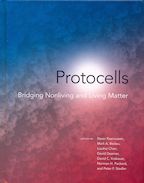
Steen Rasmussen, Mark A. Bedau, Liaohai Chen, David W. Deamer, David C. Krakauer, Norman H. Packard, Peter F. Stadler.
Protocells: bridging nonliving and living matter.
MIT Press. 2009

Protocells offers a comprehensive resource on current attempts to create simple forms of life from scratch in the laboratory. These minimal versions of cells are entities with lifelike properties created from nonliving materials; the book provides in-depth investigations of processes at the interface between nonliving and living matter. Chapters by experts in the field put this state-of-the-art research in the context of theory, laboratory work, and computer simulations on the components and properties of protocells. The book also provides perspectives on research in related areas and such broader societal issues as commercial applications and ethical considerations.

The book covers all major scientific approaches to creating minimal life, both in the laboratory and in simulation. It emphasizes the bottom-up view of physicists, chemists, and material scientists but also includes the molecular biologists top-down approach and the origin-of-ljfe perspective. Ihe capacity to engineer living technology could have a enormous socio-economic impact and could bring both good and ill. Protocells promises to be the essential reference for research on bottom-up assembly of life and living technology for years to come.

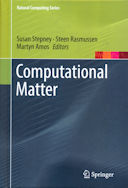
Susan Stepney, Steen Rasmussen, Martyn Amos.
Computational Matter.
Springer. 2018

+

(read but not reviewed)

This book is concerned with computing in materio: that is, unconventional computing performed by directly harnessing the physical properties of materials. It offers an overview of the field, covering four main areas of interest: theory, practice, applications and implications. Each chapter synthesizes current understanding by deliberately bringing together researchers across a collection of related research projects.

The book is useful for graduate students, researchers in the field, and the general scientific reader who is interested in inherently interdisciplinary research at the intersections of computer science, biology, chemistry, physics, engineering and mathematics.